By Aditi Dalela
India is home to roughly one in five of all children in the world – around 436 million children[1]. The challenges and threats many of these children face in their early years are staggering. Across different settings and social contexts, children face a range of challenges, including malnutrition, interrupted education, trafficking, poverty, forced labour, substance use, early marriage, physical, sexual and emotional abuse, and the list goes on. A cursory search online reveals alarming statistics on the welfare of children in India:
- One in every eight children, aged 5-14 years, work for their own household or someone else[2].
- The Indian National Crimes Records Bureau (NCRB) reports a child is sexually abused every 15 min[3].
- Around 42 percent of adolescent girls aged 15-19 years are undernourished[4].
- One in every six urban Indians live in slums[5].
- Nearly one in four young women in India were married or in union before their 18th birthday[6].
However, these data cannot possibly capture the tangle of issues and conditions that contribute to child protection issues in India. In one of the first few lectures I attended in my public health program, we discussed ‘wicked problems’ – problems that are multi-causal, multi-scalar, and interdependent. These are problems that don’t have a clear diagnosis – rather, the angle from which you look at them provides you with a different understanding of their roots. Child protection in India meets this definition of a wicked problem, and any response must engage with multiple systems, play a careful balancing act, and attempt to untangle the web of problems. As I started my internship with Leher, I hoped to set aside my preconceptions about the challenges children face in India and instead gain a deeper understanding of the child welfare landscape by directly observing and engaging with communities across different social and environmental contexts in Maharashtra. In particular, I aimed to compare the problems children face and the ways in which the community-led child protection program was functioning in rural and urban settings.
Over the course of two weeks, I had the opportunity to travel to two districts in Maharashtra, Nandurbar and Mumbai Suburban, where the community-led child protection program is underway. I had discussions with Child Protection Committee (CPC) and Children’s Group (CG) members, trying to understand the problems that children face in the community and their efforts to intervene in or respond to these problems. Importantly, I witnessed first-hand the environment children interact with on a day-to-day basis, and the changes in these environments as a result of CPC and CG advocacy. While entering the Nandarkheda village on a bumpy auto ride, we saw the recently initiated road construction on the previously kaccha rasta leading into the village. Later, the children told us that they were the ones who had raised this issue of the road being unclean and dangerous at the gram sabha. In Laxmi Nagar in Mumbai, after meeting with the Anganwadi worker, we crossed a few toilets with no doors which are no longer in use because the CPC raised this issue with the nagar sevak and there are now closed toilets in use in the community. My visits to Nandurbar and Mumbai Suburban showed me that change and progress simultaneously look very different and very similar in diametrically opposite landscapes.
Landscape and Built Environment
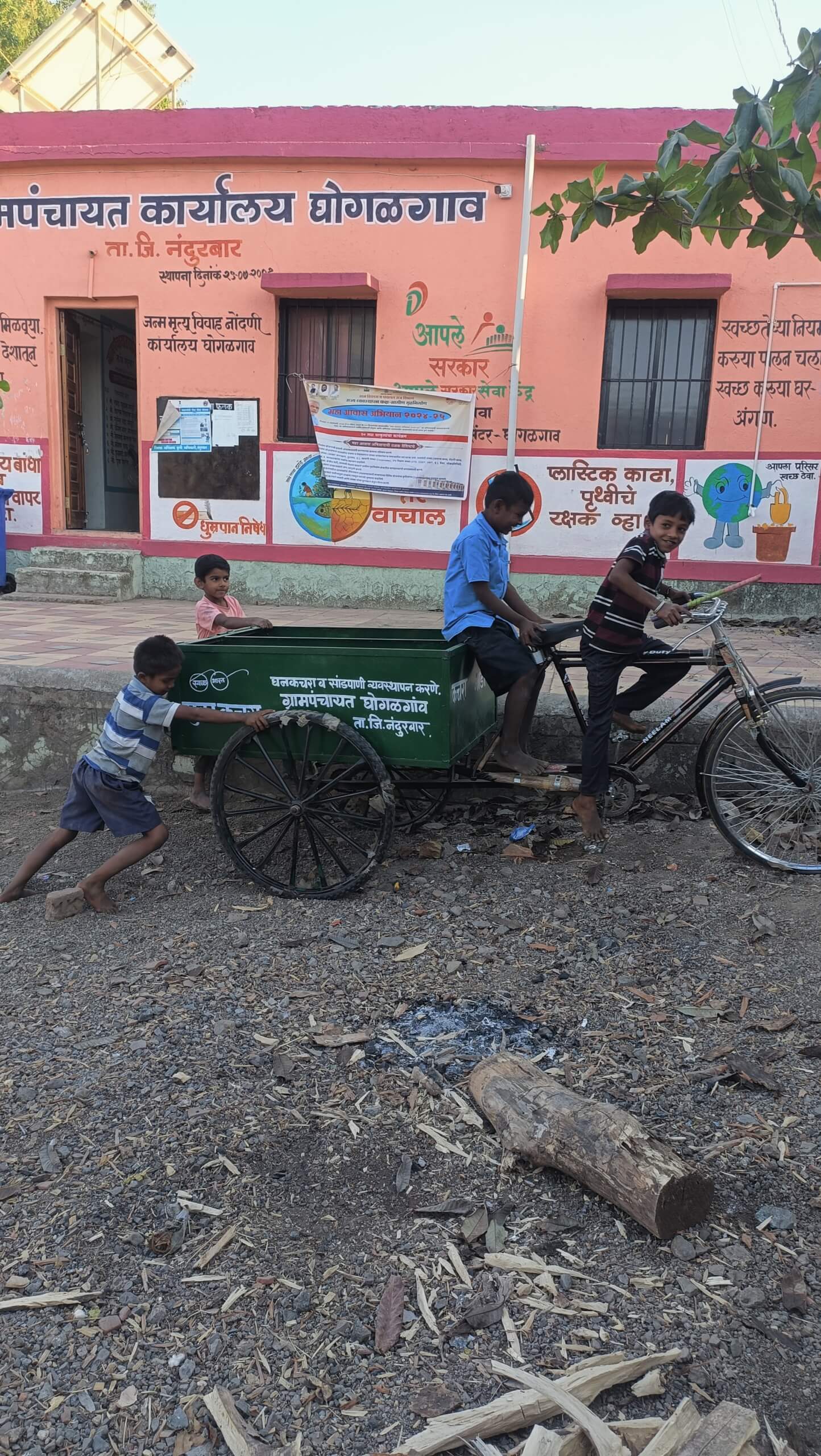
Driving into Nandurbar, the landscape is dotted with dense forests and fields of sugarcane and cotton. Many people work in these fields or nearby towns and villages and return in the evening. Otherwise, the villages seem to be self-sufficient, with a school, school ground, Anganwadi center, homes, a Panchayat office, and a few more buildings, sprawled across the land. As I look over a map created by the community of the spaces that children inhabit in their village, I notice that the CPC and CG members have identified every single family’s home, making note of children who do not attend school regularly. Despite the perceived expansiveness of the landscape, the community is tight-knit, and families know each other. In contrast, the communities we visited in Mumbai Suburban were much more populated and congested. We navigated a maze of gallis to reach a less busy one where we could meet CPC and CG members. Space was scarce, but the children continued to play in the narrow lanes and patches of open space. In our discussion with CPC members, they spoke about how the meetings have allowed them to identify vulnerable families in their community, who they didn’t know were struggling previously. Despite their proximity to each other, families don’t necessarily know each other in these communities.
The social landscape in an urban context is inherently more complex, characterized by dense populations where individuals from starkly diverse geographic, linguistic, cultural, and socio-economic backgrounds converge. This mosaic of identities often leads to fragmented community networks, transient relationships, and competing priorities, which can obscure shared values around child welfare. Such diversity also means that there are various types and degrees of vulnerability and risk in children from a single community, which need to be mitigated in nuanced ways. In contrast, in rural settings, communities are more tight-knit and bound by traditions and collective norms. In the district of Nandurbar, for example, child protection efforts in some villages confronted challenges rooted in geographic isolation, limited access to resources, and deeply ingrained cultural practices that conflict with a modern child rights framework.
In both the urban and rural context, the built environments are flawed in that they are fundamentally not child-friendly. Some common issues we discussed with CPC and CG members in both Nandurbar and Mumbai Suburban include a lack of properly constructed, separate, and accessible toilets; limited water supply sources; poorly constructed roads and paths; poor lighting in public spaces; and a lack of open green space for play. In Mumbai, infrastructure problems were further compounded by the presence of nalas, issues with drainage and waste management systems, and an excess of garbage.
The ‘Child’ in Rural and Urban Maharashtra
The position of a child is framed by the social, economic, and cultural conditions of their context. In the communities I visited, I found that the children reflected and adapted to the conditions imposed on them. In Nandarkheda, a young boy stood silently as his sister explained to us that their parents had migrated for work, and he missed them. The following week, in Mumbai, we visited a community in Goregaon, where groups of children were joyfully playing and flying kites in a small, open space at the heart of the neighbourhood, making the most of every inch of the area they had. Undoubtedly, children adapt and cope in their own ways.
When I asked the children’s groups in Nandurbar and Mumbai Suburban about the problems children face in their village or neighbourhood, they raised various issues, including unsafe spaces, substance use, bullying and discrimination, verbal abuse, and problems with public facilities such as toilets. In Nandurbar, issues such as child marriage, child labour, school dropouts and irregular attendance, and caregiver migration were raised during discussions as well. Yet, in the villages we visited, many of these issues—often stereotyped as ‘rural problems’ – proved far less pervasive than I had anticipated. Communities demonstrated a strong grasp of the harms of child marriage and labour, with VCPC members proactively addressing cases as they emerged, their vigilance belying assumptions about rural passivity. In urban areas, child marriage and issues related to school attendance were rare. Instead, children spoke more about substance use, gambling, mobile phone addictions, and verbal abuse – all issues that were exacerbated if adults were modeling or encouraging these behaviours.
Shifting Attitudes and Community Empowerment
Perhaps the most elusive changes within communities occur in the underlying attitudes and perceptions that frame child welfare issues. It was evident from conversations with CPC and CG members that their perception of their own work in preventing and responding to child wellbeing issues had changed over time. Any doubts or hesitancy they had were replaced with a felt sense of empowerment, responsibility, and value in their role. In the CG discussion in Bhagat Singh Nagar in Mumbai, the children spoke about feeling equipped with information and knowledge about child rights, and the space to think about ways they can make their environment safer (“khudse khud ko kaise protect kar sakte hain”).
The CG’s activities and advocacy are contributing to a re-positioning of children within communities, in both Nandurbar and Mumbai Suburban. In a few villages in Nandurbar, children have presented their concerns in the gram sabha, and local decision-makers have listened and acted on their concerns. The construction of the road leading into Nandarkheda and the process of constructing separate toilets for girls and boys in the school has begun as a result of the CG’s voice and action. In Mumbai Suburban, one CPC member shared, “Sometimes we are wrong, and the children are right. We should listen sometimes.” (“Kabhi kabhi hum galat hote hain, aur bachche sahi hote hain. Humain unkee baat sunnee chahiye.”). In one community in Mumbai, children drew and put up posters in an area full of trash, asking people not to throw their waste there. Over time, they noticed that people listened and there was less trash. Children are not only exposing neglected community issues – crumbling infrastructure, unsafe sanitation access, and waste management gaps – and framing them as urgent threats to their own safety, but they’re also rallying adults as allies, transforming community skepticism into collective action for change.
The perception of those not directly involved with the CPC and CG is also gradually shifting in Nandurbar and Mumbai Suburban. Often members of the committees are asked, “What do you do there?” and “Why are you wasting your time?”, but these comments only provide an opportunity for CPC members to share their progress and invite others to participate. As CPC and CG activities are brought to the broader community – through exhibitions, rallies, poster campaigns, and interactions with local leaders – recognition of child welfare issues is heightened, motivating collective concern and action.
At its core, the challenges tackled by members of the CPC and CG are not isolated concerns, but manifestations of deeper systemic flaws – problematic urban infrastructure and design, the marginalization of children’s needs in policy agendas, and entrenched societal hierarchies and inequities—all of which fuel the wicked child protection problem. Yet even modest, community-driven interventions hold profound power: they act as catalysts, not only chipping away at structural inequities through grassroots engagement but also gradually reshaping how society perceives and prioritizes the welfare of its youngest members.
[1] https://data.unicef.org/how-many/how-many-children-under-18-are-there-in-india/
[2] https://www.unicef.org/india/key-data
[3] https://pmc.ncbi.nlm.nih.gov/articles/PMC8354262/#R20\
[4] https://www.unicef.org/india/key-data
[5] https://pmc.ncbi.nlm.nih.gov/articles/PMC8354262/#R20
[6] https://data.unicef.org/resources/ending-child-marriage-a-profile-of-progress-in-india-2023/