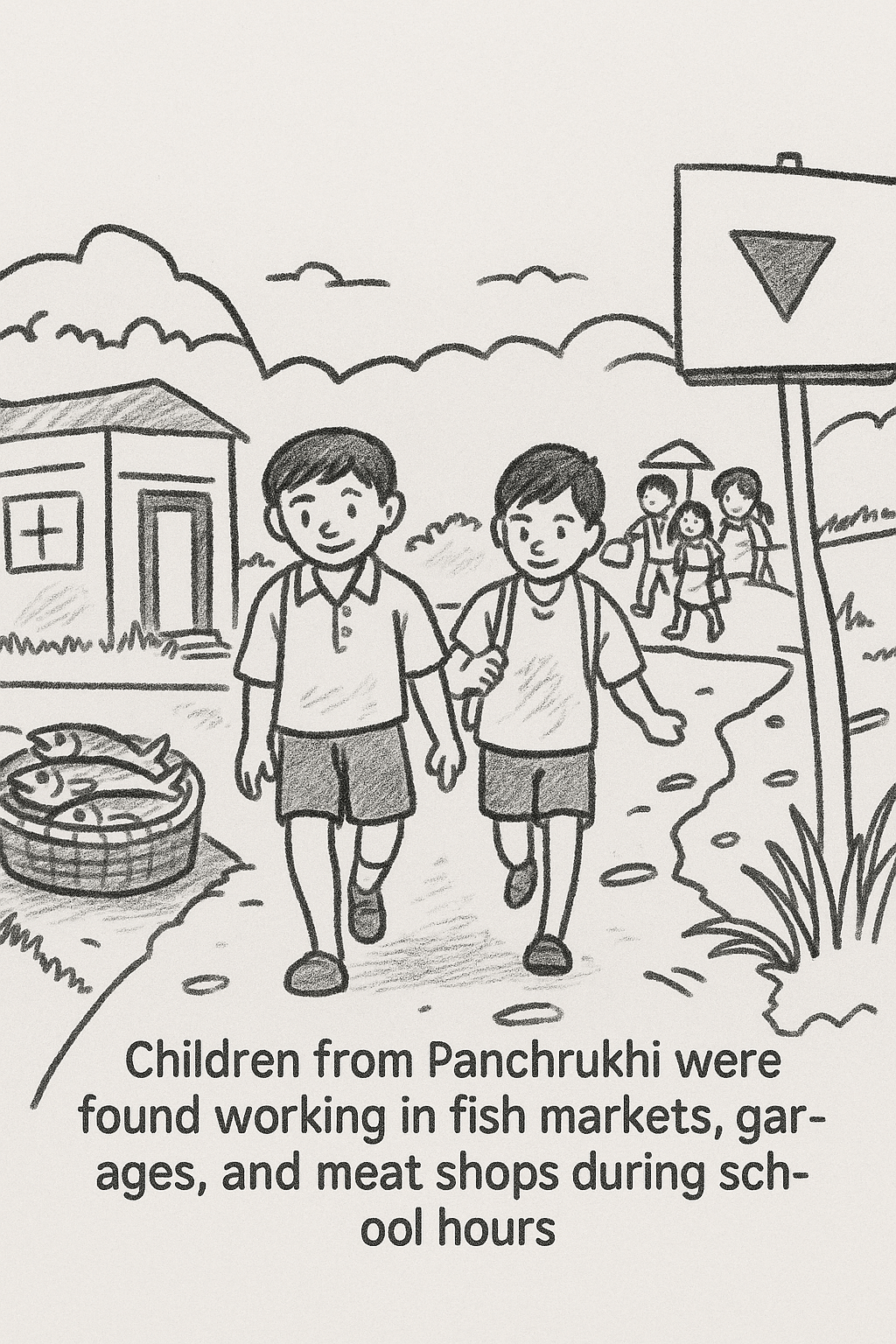
Panchrukhi is a village with a population evenly divided between two primary livelihood groups. One half belongs to the fishing community, categorized as Scheduled Caste (SC), while the other half consists of daily wage laborers, farmers, and small shop owners. The neighboring village of Simulia, located about 1.5 km away, houses a fish and meat market where fish caught by the Panchrukhi fishing community is sold. The fishing community members engage in fishing early in the morning, sell their fresh catch at the market, and then work as daily laborers in agricultural fields, similar to other villagers.
The fish market in Simulia is part of a larger commercial area spanning a one-kilometer radius. At the fish and chicken markets, fish and chickens are washed, cleaned, slaughtered, and sold while ensuring their freshness. Among those working at the market are children aged about 13 and above, who assist their families. Many parents remain unaware that their children are working instead of attending school. In addition to working in fish and meat shops, children are also found working in other businesses, such as bike repair garages. These children often go to the market during school hours, engaging in both work and play. They return home around 4 p.m., at the time regular school hours end. However, their parents, who assume they are attending school, remain unaware that their children have dropped out.
During a Children’s Group (CG) monthly meeting, a participatory community mapping exercise was conducted to identify out-of-school children. Following this, the issue was discussed with the Village Child Protection Committee (VCPC), which decided to conduct home visits and raise awareness among parents. When VCPC members visited homes, parents initially denied the claims and insisted their children were attending school. However, during a group discussion organized by the VCPC, parents acknowledged that they had assumed their children were in school since they themselves were away at work during the day. To verify the matter, VCPC members visited the school, spoke to teachers, and checked attendance records based on the CG’s information. The records confirmed that the identified children had been irregular for approximately three to four months. This led to further home visits and follow-ups by CG and VCPC members.
Despite follow-up efforts, the children continued working. The VCPC reported the issue to facilitators and sought support. With their help, the VCPC contacted the District Labour Department and scheduled a rescue operation. The task force included police personnel, district labour officials, the Block Labour Officer, and one of the facilitators. Key VCPC members guiding the task force included Navkumar Barik (a village leader and Ward Member), Sujay Kumar Parida (an ordinary community member), and Raimon Patra (VCPC President).
During the operation, nine boys were rescued—eight from Panchrukhi and one from the neighbouring village of Kagadapal. Among them, four were under 14 years of age. Four children were rescued from fish and chicken shops, while five were found working at a bike repair garage. The rescued children were produced before the Child Welfare Committee (CWC) and placed in a shelter home for four to five days until due processes were completed. During the CWC hearing, parents were called and asked to submit an undertaking promising they would not engage their children in labour. The CWC then restored the children to their families.
Through continuous follow-up visits by CG and VCPC members, the four younger children resumed regular school attendance. However, the older children attended school inconsistently. CG members emphasized the long-term impact of early labour and school dropout, highlighting that lack of education would confine these children to unskilled labour. Parents of older children expressed their helplessness, citing their children’s lack of interest in studies. The younger children who resumed schooling received all necessary scholastic materials under the Sarva Shiksha Abhiyan. Meanwhile, the VCPC explored rural vocational training opportunities for the older children but found that no such programs were currently available for boys.
The case of Panchrukhi highlights both the vulnerabilities children face in marginalized communities and the power of collective, community-led action. While economic hardship often pushes families to make difficult choices, this experience showed that awareness, dialogue, and persistent follow-up can lead to meaningful change. The collaboration between the Children’s Group, VCPC, and district authorities not only helped rescue children from exploitative work but also laid the groundwork for preventive action and sustained community vigilance. Although challenges remain—especially in engaging older children and addressing systemic gaps like the lack of vocational training—Panchrukhi’s efforts stand as a testament to the potential of grassroots mechanisms in safeguarding childhoods and shaping better futures.