Panchrukhi, a large village with a thriving community engaged in fishing, agriculture, and small
businesses, had long struggled with a major gap in early childhood care—the lack of a proper
Anganwadi centre. Despite the village’s growing population, only one Anganwadi was functioning, and
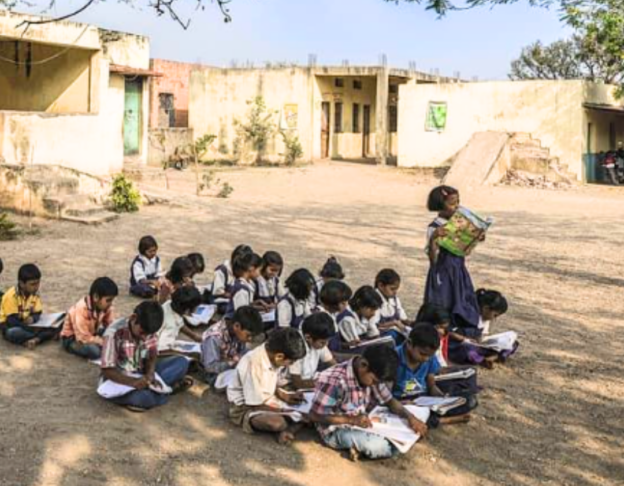
even that lacked proper infrastructure. Instead of a dedicated space, the Anganwadi operated from
the veranda of the primary school, accommodating about 30 young children. This arrangement was
far from ideal.
The primary school itself was overcrowded, with over 60 children but only three classrooms. Teachers
had no choice but to combine different grades in a single room, making learning difficult. Meanwhile,
the Anganwadi worker struggled to engage the younger children properly in the open veranda, where
distractions were endless. For years, this lack of space and resources made it challenging for both the
school teachers and the Anganwadi worker to fulfill their duties effectively.
In February 2024, during a Village Child Protection Committee (VCPC) meeting, the issue was once
again brought up. The Anganwadi worker, also a VCPC member, raised concerns about the
inadequate space and infrastructure.
A few community members present at the meeting also voiced their frustration, emphasizing how
essential it was to have a proper Anganwadi centre. The matter had already been taken up with the
Child Development Project Officer (CDPO) before, but progress had stalled. The CDPO had
acknowledged the issue but pointed out a major hurdle:
“There is no available land for construction. If land is identified, funds can be sanctioned.” For the
VCPC and the community, this was a turning point. They realized that unless they pushed harder, the
issue would continue to be ignored.
Determined to bring about change, the VCPC took the matter to the Gram Sabha in August 2024. By
then, the VCPC had already built a strong working relationship with the Panchayat, having previously
collaborated on school repairs, including installing fans and fixing infrastructure. The Panchayat had
even released ₹50,000 for school improvements, showing their commitment to children’s welfare.
During the Gram Sabha discussion, something significant happened—
A piece of public land right behind the school was identified as a potential site for the Anganwadi.
With support from the community, VCPC, and the Panchayat, this proposal was finalized. A formal
request letter was submitted to the Block Development Officer (BDO), urging the release of funds for
construction.
Once the BDO approved the proposal, things moved swiftly. A junior engineer visited the site to
assess its feasibility. Once he gave the green light, the budget was sanctioned, and by December
2024, construction had begun—not just for one but for two Anganwadi centres!
For many in the community, especially the VCPC members, the speed of progress was unexpected
but deeply satisfying. "We thought this problem would never be solved," one community member
admitted. Seeing the construction begin felt like a long-awaited victory. Some community members
were so overjoyed that they took a group picture in front of the newly constructed foundation, marking
the beginning of a better future for their children.
In the January 2025 Gram Sabha, the Sarpanch formally thanked the VCPC for their efforts. "This
wouldn’t have been possible without your persistence," he said, recognizing the VCPC’s
determination, the community’s advocacy, and the Panchayat’s cooperation.
Now, with two fully functional Anganwadi centres under construction, Panchrukhi’s children would
finally have a safe, dedicated space for early learning, nutrition, and care.
While the issue of inadequate space for an Anganwadi Centre had persisted for years, it was the
unwavering efforts of the VCPC over a 12-month period ( Feb24- Jan25) that finally led to tangible
change. The VCPC’s role went far beyond raising a complaint— went from gathering evidence of
overcrowding and inadequate infrastructure to the VCPC engaging with administration and the
Panchayat that brought around change.
Also, Anganwadi Workers, often expected to deliver services with limited support, are now finding a
strong ally in the VCPC. As active members, they are voicing challenges more openly and seeing
collective follow-through. The VCPC has become a platform where frontline workers are heard and
supported.
The resolving of this longstanding issue- construction of the AWC has strengthened the VCPC’s
credibility as a key community institution for child protection and development. Their efforts not only
improved infrastructure but also demonstrated how local governance can be made more responsive
and accountable. Recognition from the Panchayat and broader community has further validated the
VCPC’s role and value.
This case stands as a testament to what is possible when community mechanisms like the VCPC are
active and persistent.