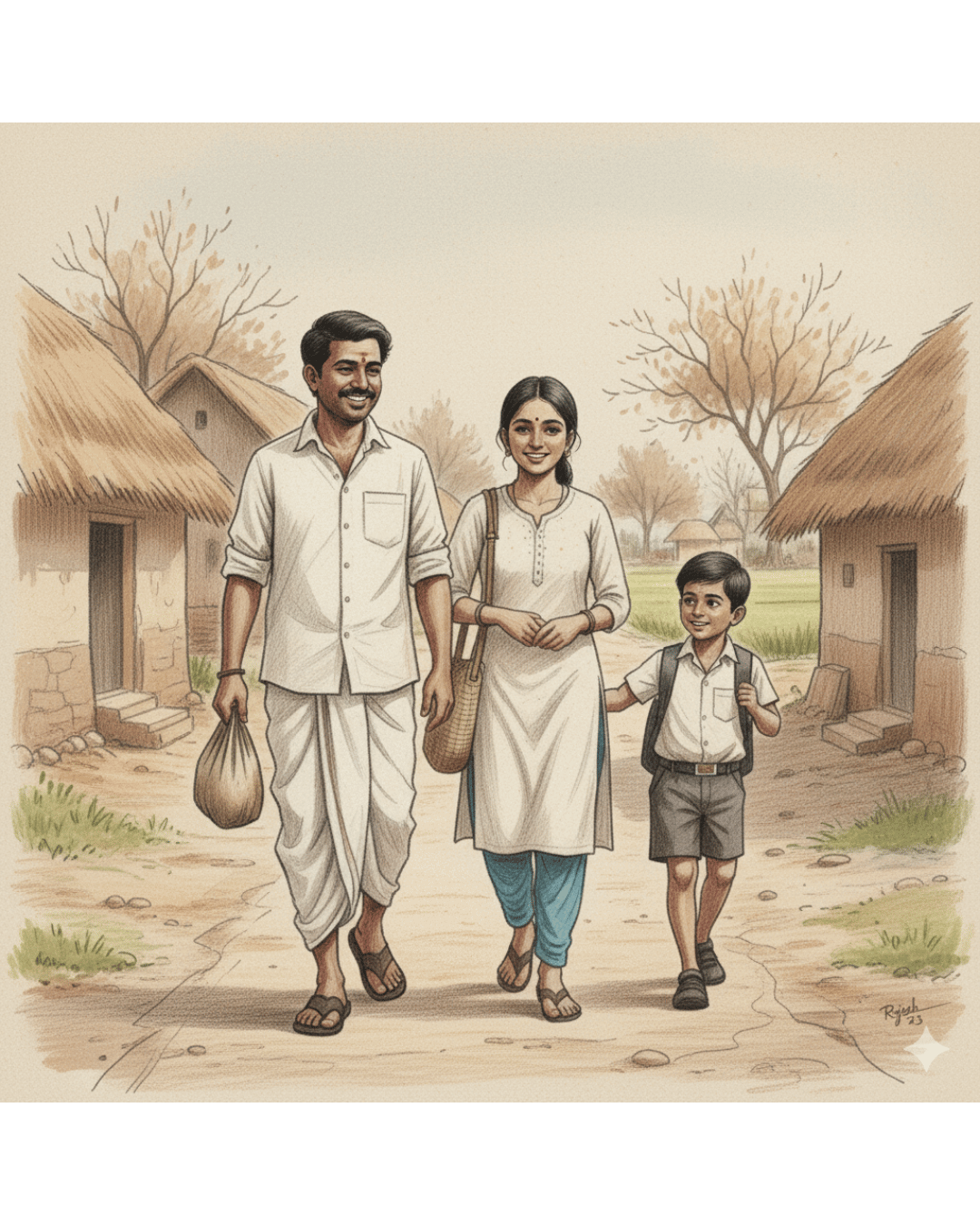
In the remote village of Patlipada, located in the Nandurbar district of Maharashtra, 16-year-old Disha Sanjay Ingle faced the risk of dropping out of school due to deep-rooted social norms, safety concerns, and migration-related challenges. Although she had successfully completed her 9th grade, Disha’s path to education came to a halt when her father refused to let her continue, citing safety issues and the absence of a female companion for the long daily commute to school, which was 7 km away in Nandurbar block. Her only friend and walking companion had recently moved to another village, leaving Disha isolated and vulnerable.
Nandurbar district sees high levels of seasonal migration, and children—especially girls—often face disruptions in education. During the Village Child Protection Committee (VCPC) discussions, it emerged that families tend to take their children along while migrating either for safety or support in work. Girls, in particular, are kept at home to care for younger siblings or are denied education under the belief that marriage is their ultimate fate. This cultural mindset formed a barrier that the VCPC and the Children’s Group (CG) were determined to overcome.
Disha 's case was first identified by the CG during a community mapping exercise in April 2024. A follow-up discussion in the VCPC’s routine meeting in May brought the issue to wider attention. The CG, supported by an ASHA worker and a few CG children, conducted a home visit to better understand her situation. Disha expressed her strong desire to continue studying but revealed that her father feared she might "go astray" if allowed too much freedom. She gradually lost interest in school due to isolation and repeated restrictions.
Her younger brother, a member of the CG, was the first to raise concerns about her absence from school during a CG meeting. Recognizing the urgency, the VCPC—with support from CG members, ASHA workers, a youth group member, and a School Management Committee (SMC) representative—launched a series of sustained interventions. Over the span of two months (May and June), they conducted nearly seven home visits to counsel and convince Disha ’s father. Initially, he reacted with resistance—at times growing angry and even threatening the ASHA worker who lived nearby. But the VCPC remained unwavering in their commitment.
In these visits, VCPC members used historical references like Savitribai Phule to emphasize the value of girls’ education. They brought in influential voices from the community, including the Sarpanch, schoolteachers, police officers, and Panchayat members, to lend weight to their advocacy. The facilitators coordinated closely with Hira Kaka Chaudhari Shaiksanik Sankul, a trust-run school where girls’ education is free, thanks to support from the local MLA. VCPC members visited the school twice to coordinate Disha 's re-admission and monitor her attendance.
Ultimately, their persistent and respectful approach led to a breakthrough. In July 2024, Disha was re-enrolled. Though she initially felt overwhelmed—describing a sense of "blankness" in her studies after a 40-day gap—she quickly regained her footing. Her father, once opposed, began personally dropping her to school on some days. Her mother, though anxious, expressed deep gratitude: “I want to teach my daughter. I have a lot of hopes from you all (VCPC). I am very thankful for the efforts you’re taking.”
Today, a year later, Disha is regularly attending school and preparing for her 10th standard exams. The ASHA worker, who lives nearby, continues to monitor her attendance and provides updates in VCPC meetings. The committee has also observed a ripple effect—no other child in the village is currently irregular to school, a testament to the collective vigilance and commitment of the community.
Over the past three years, since the formation of the CG, a quiet but powerful transformation has taken root in Patlipada. What began as a space for children to meet and share their concerns has evolved into a vital mechanism for collective problem-solving. The active involvement of Disha’s younger brother illustrates how CGs are nurturing a generation of children who not only recognise issues but also act on them, thereby becoming agents of change within their families. Disha’s case highlights VCPC’s ability to rally allies, from the Sarpanch to the police, and demonstrates a growing community consensus around shared responsibility for child protection. This case also presents the importance of investing in sensitising, building the capacity of CGs and VCPCs and engaging with local governance not as parallel structures but as an integral part of community development and resilience.