
In Bhosa, a village in Yavatmal district, the story of two young sisters, Pranjali (11) and Divya (10), became a testament to the power of a community's commitment to its children. Born into a life of hardships, the girls faced tragedy after tragedy. Yet, their lives took a hopeful turn thanks to the efforts of a proactive Nagar Sevak and the collaborative strength of the Village Child Protection Committee (VCPC), Childline, and the Child Welfare Committee (CWC).
The sisters’ ordeal began years ago when their mother, caught in a tragic domestic situation, was murdered. Their father, devastated, returned to Bhosa with the girls to live with their grandmother. Despite the challenges, the family found some semblance of stability until December 2023, when their father passed away.
Their grandmother stepped in as their caregiver. Pranjali and Divya, barely coming to terms with the loss of their parents and adjusting to the life in rural Bhosa had to soon see their grandmother pass away, leaving the girls orphaned and vulnerable. Their paternal aunt, who lived in a nearby village, took temporary responsibility, enrolling them in school and providing for their immediate needs. However, with her own family to care for, she soon realized that she could not continue to look after the girls. Fearing societal risks of raising two young girls and overwhelmed by her limited resources, she sought help.
Recognizing the severity of the situation, the aunt turned to the village’s Nagar Sevak, who was a member of the gram panchayat, Bharat Bhramankar. Bharat, known for his active involvement in community matters, immediately contacted the facilitator working closely with the VCPC. Aware of the child protection mechanisms in place, Bharat asked if anything could be done for the girls.
The case was presented to the VCPC, where it sparked an urgent discussion. The VCPC immediately met and had a discussion with the aunt to understand the situation. Understanding that the sisters needed more than temporary assistance—and that they needed a stable and nurturing environment. It was decided to reach out to the Child Helpline (DCPU) for support.
The next day, a team comprising the Leher community facilitator, Helpline representatives, and VCPC members visited the family. They assessed the situation, spoke with the girls and their aunt, and documented the case. Child Helpline quickly prepared an application for the CWC, outlining the sisters’ circumstances and recommending shelter support.
Within a month of receiving the case, the CWC approved the placement of Pranjali and Divya in a shelter home in the Phursad block. The home offered a secure environment where the girls can live until they turn 18. They were enrolled in school, given access to educational resources, psycho-social support and began adjusting to their new surroundings.
The shelter not only provided stability but also maintained a connection to their family. The aunt was granted permission to visit them and bring them home for short stays, ensuring the girls didn’t feel isolated from their roots.
This journey was not without its hurdles. The aunt’s hesitation to take on long-term care reflected a broader societal challenge of supporting orphaned children, particularly girls. Additionally, the sisters’ earlier trauma required a sensitive and timely approach to avoid further harm.
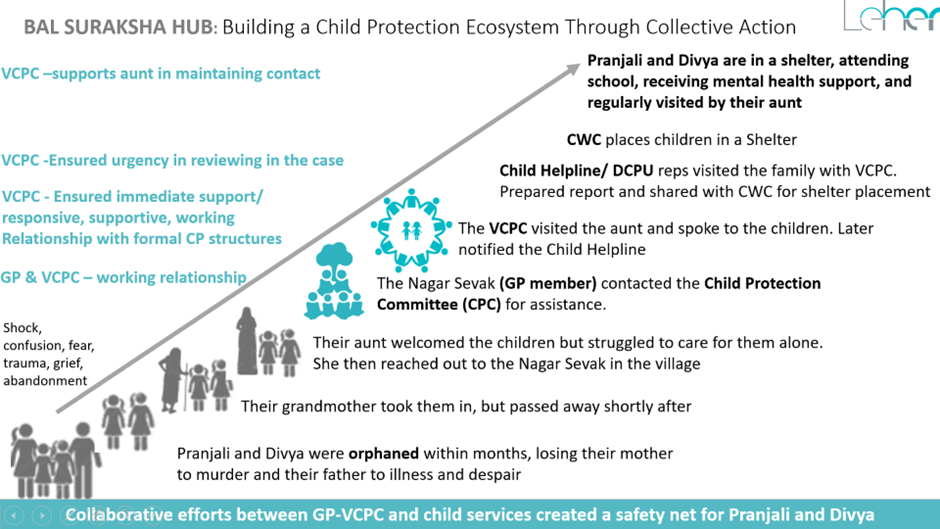
What needs to be observed here is there is no single hero in this story. It was the alertness and awareness of the Nagar Sevak that got the VCPC involved. It was the prompt action of the VCPC visit, coordinating with the Child Helpline to make the visit and the continued support to the aunt that helped Pranjali and Divya. While Pranjali & Divya went through a series of unfortunate losses, it was the Bal Suraksha Hubs ( i.e the GP-VCPC), the child protection services collaboratively working together ensured the two girls did not fall through the safety net.
True many children may not go through the same circumstances as Pranjali and Divya, but each deserves to thrive in a safe environment. Mission Vatsalya and the recent govt order focussing on localisation of SDGs too promotes for child friendly villages/wards. The BSHs being the closest to the child and family is best positioned be alert, support families, reach out to formal child protection services and structures and strengthen the ecosystem around the child.
Today, Pranjali and Divya are settling in the shelter home. They attend school regularly, have access to a counselor, and are surrounded by a community that genuinely cares for their well-being. Their aunt’s continued involvement gives them the comfort of knowing they still belong to their family.
Through collective action, Bhosa showed that even in the face of tragedy, a community can rally together to give its children a chance at a brighter future.