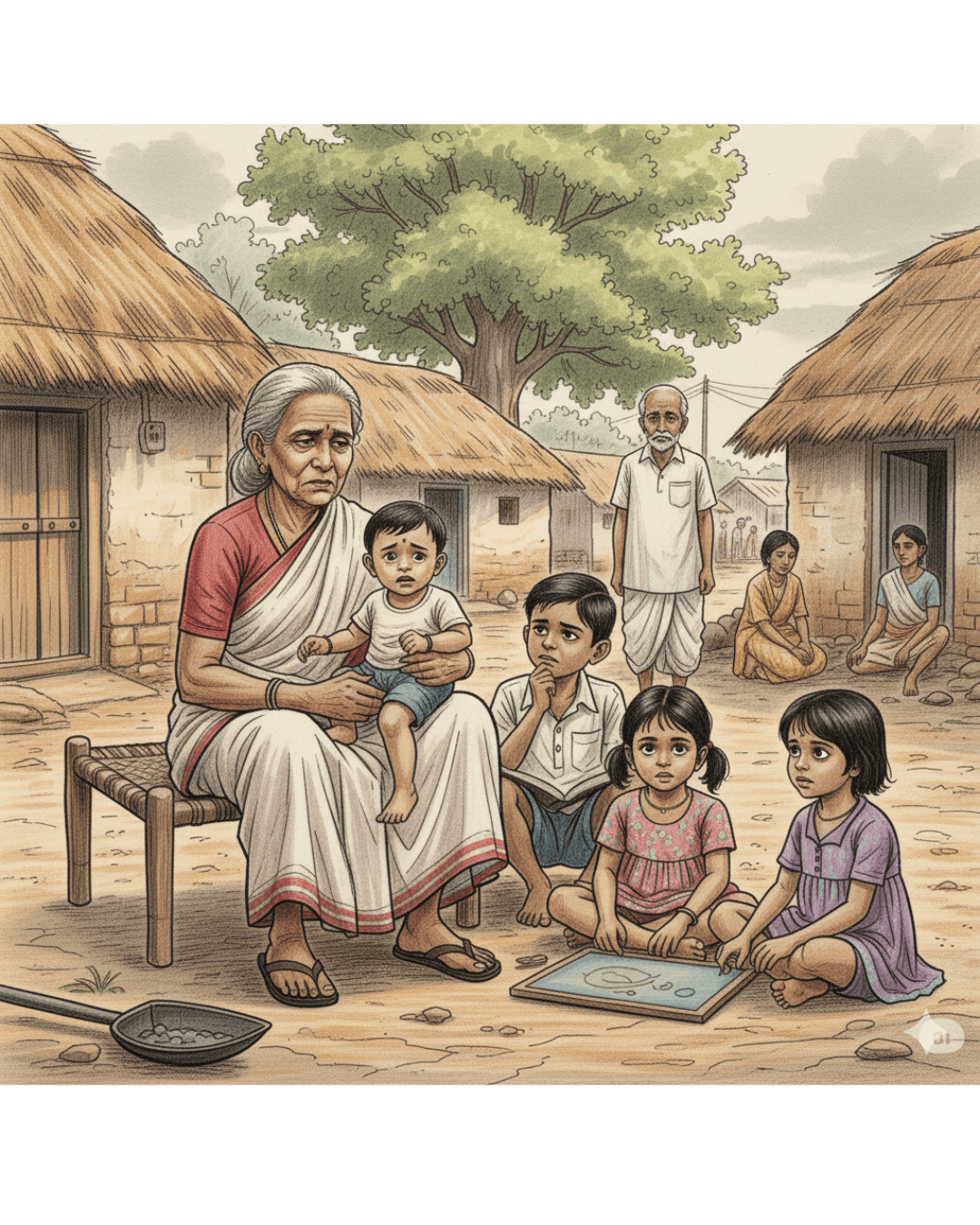
In July 2025, during a Village Child Protection Committee (VCPC) meeting in Hasimpur, members raised a serious concern about four children from a Scheduled Tribe family who had recently lost their mother. Their father had abandoned them 2 to 3 years earlier, leaving the siblings — two twin girls aged 7, a boy aged 9, and another boy aged 3 — in the care of their elderly maternal grandparents.
Both grandparents were over 60 and struggled to make ends meet through occasional daily wage agricultural work, which provided about ₹300 a day. They could find work only 2 to 3 days a week and survived partly through old-age pensions and ration card support. Their home, a one-room concrete structure with an asbestos roof, did not even have a door. To complicate matters, the grandfather often drank handiya (a locally brewed alcohol) and was irregular in his work.
One of the VCPC members who lives near the children heard about their dropping out of school in June, and brought it to the VCPC meeting. They had dropped out of school to help their ailing mother with household chores. After her death, none of the three school-aged children attended school, despite the village primary school being just a few minutes away.
This situation alarmed the VCPC. One member reflected, “The grandparents are old, and the grandfather doesn’t work much… if they don’t get enough food, we worry they might turn to alcohol like we’ve seen in other villages.” Others recalled their training on child protection laws and services under the Juvenile Justice (JJ) Act, conducted in September 2024, and discussed possible solutions. Admission into a Child Care Institution (CCI) emerged as the most viable option to ensure the children's food, care, and education.
The VCPC called the Helpline 1098 for support and along with them and the Sarpanch, visited the family to understand the situation and look at the future and practically discuss what would be in the best interest of the children, the grandparents became emotional. With tears in their eyes, they pleaded, “Take everyone away, but please let the youngest stay with us… we can’t bear to leave them.” They were torn between their love for their grandchildren and their inability to provide for them. Patiently, the VCPC and community leaders explained the risks of leaving the children in their current situation and reassured the grandparents that this step was necessary for the children's safety and future.
Eventually, the grandparents agreed. On August 5, 2025, the four children were formally admitted to a CCI in Balasore headquarters, about 70 km away, under the guidance of the Child Welfare Committee (CWC). For the first time in months, the children had a safe environment, nutritious food, and the opportunity to return to school.
This intervention also provided some relief for the grandparents. As one VCPC member noted, “The children are now in a safe place where they can attend school, and the burden on the grandparents has lightened.”
This case illustrates how knowledge of child protection structures can lead to timely, life-changing actions. Faced with the sudden death of their mother and the inability of their elderly grandparents to provide stable care, the VCPC, supported by the Sarpanch, Childline, and the CWC, acted decisively to secure the children’s well-being.
At the same time, the story highlights the complex emotions and dilemmas that arise when children are placed in institutional care. While the CCI offers immediate safety, food, and education, questions remain about the children’s long-term future: How will their bond with their grandparents be maintained? Could family-based government schemes have been explored as alternatives? What reintegration options might be possible down the line?
Above all, this case reflects both the strengths and challenges of community-based child protection. It demonstrates that communities can act quickly to protect children in crisis, while also emphasizing that sustainable, child-centered solutions rooted in family and community care must remain the ultimate goal.