
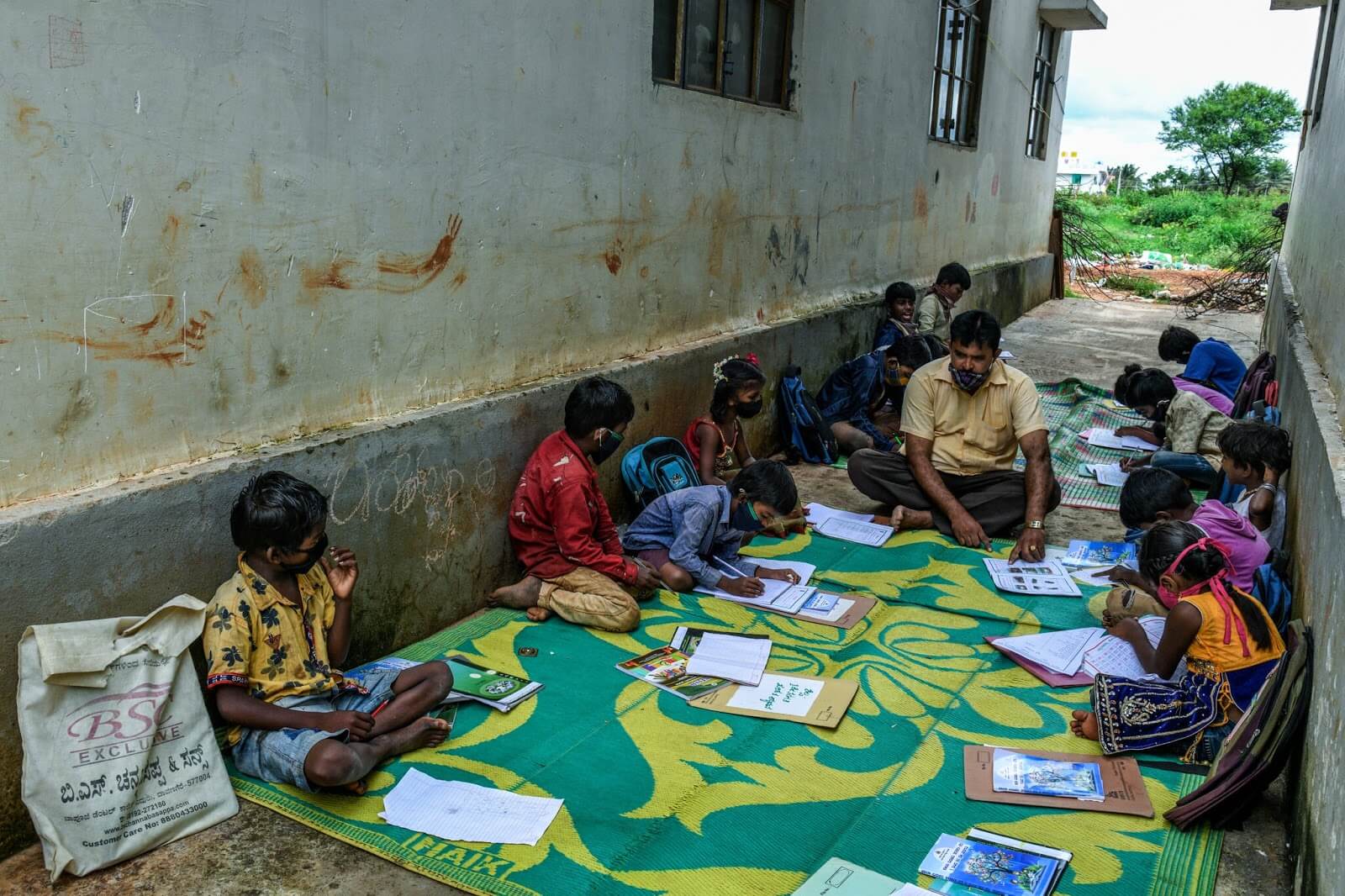
Isn’t it ironic that the very reason that prevented the spread of Coronavirus- staying indoors has made children more vulnerable?
Unless we start taking the realities of children that comprise 39 % of our population seriously, the rights of children shall remain violated, robbing them of their childhoods.
While we shared pandemic positive stories in one of our previous blog, in this blog, we present a different perspective and share how one year of the lockdown and the pandemic violated the rights of children.
1. How the pandemic widened the gap in education

Schools are more than a place where children come to learn and gain an education; Creating a nurturing environment, schools play an important role in the holistic development of a child. While school closures led governments and civil society to come up with innovative ways of online learning, access to online education in remote areas remains a challenge. According to ASER’S Educational Report (2020), only one-third of India’s school children were able to pursue online education.
Even before the pandemic, the number of out of school children remained huge and according to the National Sample Survey Organisation’s 2017-18 household survey, the number of out-of-school children in India (6-17 years) at 3.22 crore. Experts say that this number will double due to the Covid-19 pandemic.
2. How the pandemic forced children to join the job market.

Even before the pandemic, according to the International Labour Organisation (ILO), 10.1 million children were either slated as ‘main worker’ or as ‘marginal worker’.
The financial loss faced by families from under-resourced communities pushed children back into the job market, and many of these children may not return to school.
3. How the pandemic pushed children into early marriage and increased the gender gap

Five countries including India account for half of the total child brides in the world according to a new report on Child Marriage that was released by UNICEF on March 8, 2021. However, experts also say the vulnerabilities of the pandemic will force children into early marriage. ‘Many girls won’t return to school because they will be kept at home for caregiving, domestic work, farm grazing and marriage. Child marriage will increase exponentially as families already see girls as a liability and getting them married off will mean one less mouth to feed’, said Safeena Husain, founder and Executive Director, Educate Girls, in this news report. The pandemic has also widened the gendered gap in school education.
An assessment on issues faced by adolescents during COVID-19 found that more boys than girls had access to digital infrastructures such as mobile phones, internet services, radio, and media. With such low access to technology, digital schooling will further disengage girls from education and widen the educational inequalities among learners,” said this news report.
4. How the pandemic impacted the mental health of children

Lack of recreational and play activities, not being able to meet friends, unable to spend time with grandparents, unable to travel during summer vacations, celebrating silent birthdays, deprived children of their freedom and impacted their mental health and well-being and increased loneliness amongst children and teenagers.
As the pandemic moves into its second year, protecting the mental health of children must be a priority. ‘Countries need to give this issue the investment it deserves, dramatically expand mental health services and support for young people in communities and schools, and build on parenting programs to ensure that children from vulnerable families get the support and protection they need at home,’ Henrietta Fore, UNICEF’S Executive Director wrote in an open letter on February 16 2021.
5. How the pandemic reduced the nutritional levels of children

More than 120 million children in India were getting Mid Day meals in schools or Anganwadi Centers. With school closures and anganwadi workers weighed down with the additional duty of working as frontline workers, the nutritional intake of children reduced drastically, impacting the overall health and well-being of children.