
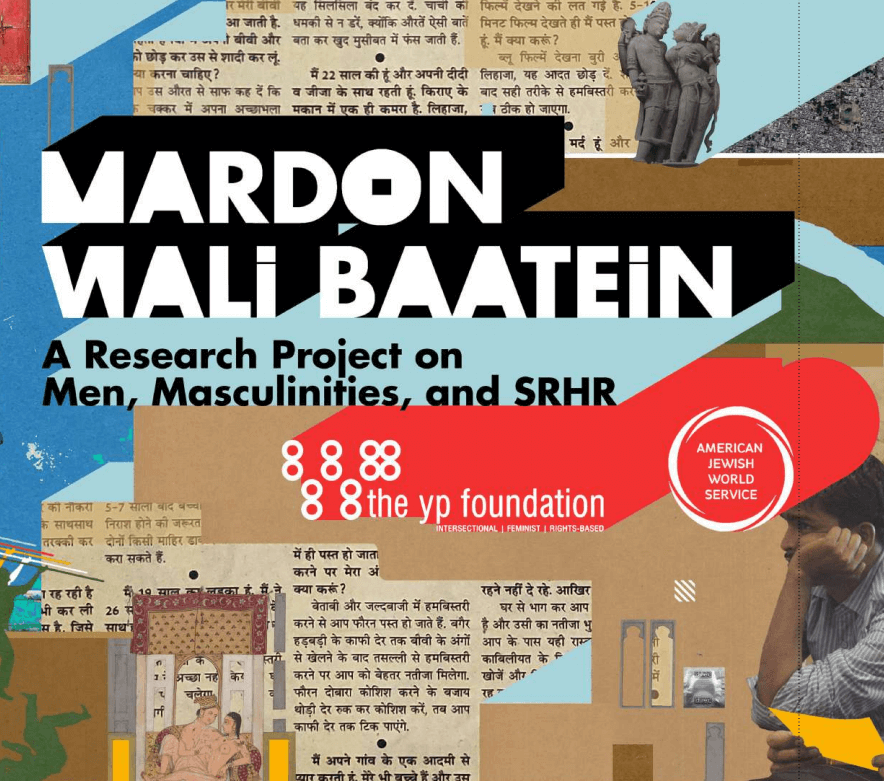
The Mardon Wali Baatien , a program by The YP Foundation, works with young people to understand, reflect on, and change their perception and practice of masculinity away from the patriarchal understandings of it as sexist, violent, and competitive. Through research and direct interventions, this programme tries to enable young people to build new and diverse definitions of masculinity. In 2018, the programme carried out research in three cities of Uttar Pradesh through personal interviews, life histories, and focused group discussions with college-going young men about sexual and reproductive health and rights (SRHR) outcomes. The research focused on understanding and highlighting their perspectives and experiences around masculinities and their performance, as well as its impact on their sexual and reproductive health.
In conversation with the team behind the program, we tried to understand how Mardoon Wali Baatien is working with men and boys in creating spaces for comfort, conversations and dialogue.
1. Oftentimes, we see that when talking about gender-based violence and gender inequality, most organisations work with adolescent girls. While YP foundation works with girls, you also have a comprehensive program for boys This may sound like a cliche question, but why was the need to begin this work specifically with boys?
Every time we talk about working with women and girls, we talk about how can we make their lives better and even when there is extensive work happening with women, it is only half the battle won. While we may see a social change happening among women, we may also see a lot of retaliation coming from men. We need to work with men and boys and have conversations with them. In doing so and by engaging with men and boys on the impact that patriarchy has on them we are creating a space for men to make their own lives better and a way for them to understand and speak about some of the challenges that they face in their own lives. We are trying to create a buy-in for men and boys for them to attend our training. Our focus is always on the impact masculinities and patriarchy have on both women and men and how we can work on changing that.
2. How do you approach the work with men and boys? Is it different from working on other programs? If yes, how so? What has your experience been so far?
In our work, when we work with men and boys we talk about their own realities. For instance, when we have conversations with women and girls, we may talk about consent and if your partner does not understand consent it is called violence. We cannot have the same conversation with men and boys. When working with boys, we speak about what happens when your partner says no. Here, our focus shifts to having conversations with men and boys on what to do when a partner says no. It is about telling them how these decisions impact them and we are working towards changing them. This applies to all of our work with men and boys. We do not tell them what not to do, but rather, we tell them how we might be carrying on this violence and the impact it may have on us.
We do not tell them how not to be violent, but rather we tell them ‘ How a non-violent space can look like, how can systems be different and we ask them: ‘How do they want masculinities to be like.’ We want to create a space of comfort and in doing so we are opening a whole new universe for them where there is no one correct answer and they can be comfortable and have their own way around masculinity. Now, this work requires a lot of reflection from the participants and it is really important in a program like ours because it requires men and boys to connect to what is happening around them in their own lives as opposed to what is happening in society. It is also about talking about how they behaved in the past in different situations and what can be done to change that.
3. Your comprehensive research ‘Mardoon Wali Baatien’ was conducted with 84 men and boys in urban spaces from UP where you spoke about the need for the intersectionality of issues. Could you share some insights from the study?
Our research moved away from treating it as a man vs women concept and the idea was to not just talk about relationships between men and women, but other forms of relationships that is relationships amongst men themselves and relationships at home. We touched on the instances of hierarchies that exist amind men. For instance, how upper caste men are expected to have a particular body and the vilification of lower caste men and how lower caste men may be expected to agree with what upper caste men are stating.
We also looked at the role social media plays and is an extension of what happens in real life, how a man’s profile picture should show muscles and a man is expected to be exactly that in real life too. However, on the other hand, for some queer men, social media becomes a safe space to express their identities. We also spoke about the idea of who is a good boy- A lot of young boys and men shared that, a good boy is someone who does not have sex and does not have a romantic interest. While young boys and men would have sex they would start hiding it from their parents and how no one would find it out. We also spoke about how violence also takes place amongst men and how men interact in public spaces during the violence.
4. Why is this intersectionality important working in the space of men and boys?
Like I said earlier, these issues are not just about men vs women and there are a lot of layers to this. In doing so, we also have to keep in mind the several privileges as well as vulnerabilities that men have and address both. The privileges are the power that the men have and the vulnerabilities would be the masculine traits they may not be able to live up to. For example, boys not having a moustache could be a moment of vulnerability. In engaging with men and boys, intersectionality becomes important and their gender is not the only issue there are thousands of issues inter-connected that affect behaviours such as livelihoods and risk-taking behaviour such as alcohol and smoking. During Covid-19, we did another study and found out that being at home and not being able to work was impacting men and boys and realised the importance of intersectionality and how organisations were working on income generation activities. Another issue of sexual and reproductive health became important when organisations were helping men with contraceptives. Intersectionality is important to keep the broader picture in mind.
5. Your research also broke the myth of certain stereotypes on male friendships and the classic ‘Men don’t cry.’ Could you elaborate on this?
Some stereotypes that are set by society, may not be true. We are told that male friendships are supposed to be a particular way, but it may not always be true. For instance, we heard men share instances of how they reached out to their friends and asked for help especially when they required financial help and would discuss some personal problems. We found that certain things were not discussed especially when it came to discussing issues of their own families. A stereotype which we found true was that men do have to have to maintain their status quo and having a girlfriend or talking about their dating life was considered a symbol of power. We also found that men would be more comfortable discussing their problems in private spaces where they were open to expressing themselves. The above stereotypes are also being challenged in these smaller and private spaces. Another stereotype that was not true at all was that men would not be interested in gender workshops like these and they would not like to change anything, however, it is not so. A lot of our conversations are around daring and that gives an entry point to begin conversations. We have seen that during breaks, a lot of men and women come up to us and informally talk to us about what is going on in their dating lives and what needs to change.
6. Could you share an instance from your work where you saw positive changes in boys and young men? What do you think brought about these changes?
A man once shared with us that in 2015, he gave a rose to a girl and that is how she became her girlfriend because she had said yes, the man asked, why shouldn’t he give a rose to every girl who he liked and then have a girlfriend. While this may seem like a valid question, I asked girls what they feel when they are given a rose. Girls shared that it makes them really uncomfortable especially when a random person gives them a rose and instances like these are frequent. The same situation was looked at differently from the point of view of boys and girls. While for a boy, it became a space to get a girlfriend, for the girls, it became a space for discomfort.
We also shared the dating experiences where men shared that they are initially nervous but after the conversation and a good time, they feel better. Girls shared that they would never go on a date with a stranger, keep their friends informed and keep messaging their friends in the middle of the date too. Our platform opened a room for dialogue and these conversations helped boys to loom at different perspectives and reflect upon how girls experienced fear which was different from their own experiences.
7. While the dialogue is the first step to having any conversation with men and boys, often people do not know how to navigate these conversations. Could you list down some ways in which caregivers such as parents, teachers, siblings and friends could have open conversations without threatening the young men and boys?
1. Stop reinforcing stereotypes on what boys should not be doing and do not share things such as ‘Men and Boys Don’t Cry.’ or things that reinforce power dynamics in the hands of boys and men. For instance, often when a teacher wants some books to be taken to the staff room, she may ask a boy to bring the heavy books or at home, a brother is expected to come along with her sister when she may have to buy something from the market to protect her and keep her safe.
2. Allowing men and boys to think and not tell them things such as ‘Be quiet’ or behave a certain way.
Allowing men and boys to come up with their own meanings and definitions of masculinities will help them in the long run. While this work is process driven and takes longer, it needs a lot more work and reflection from the caregiver’s perspective too.
3. Start talking about your own lived experiences and relationships.
This gives men and boys the space and opportunity to listen to situations similar to what they must be currently going through and opens a space for asking questions and creating a dialogue. While talking about relationships, it need be just about women, but relationships and dynamics in the family and siblings too can create lot many entry points into conversations.
4. Create a safe space for men and boys to share
Allow a non-judgemental space where men and boys can reflect, make mistakes and ask questions.