
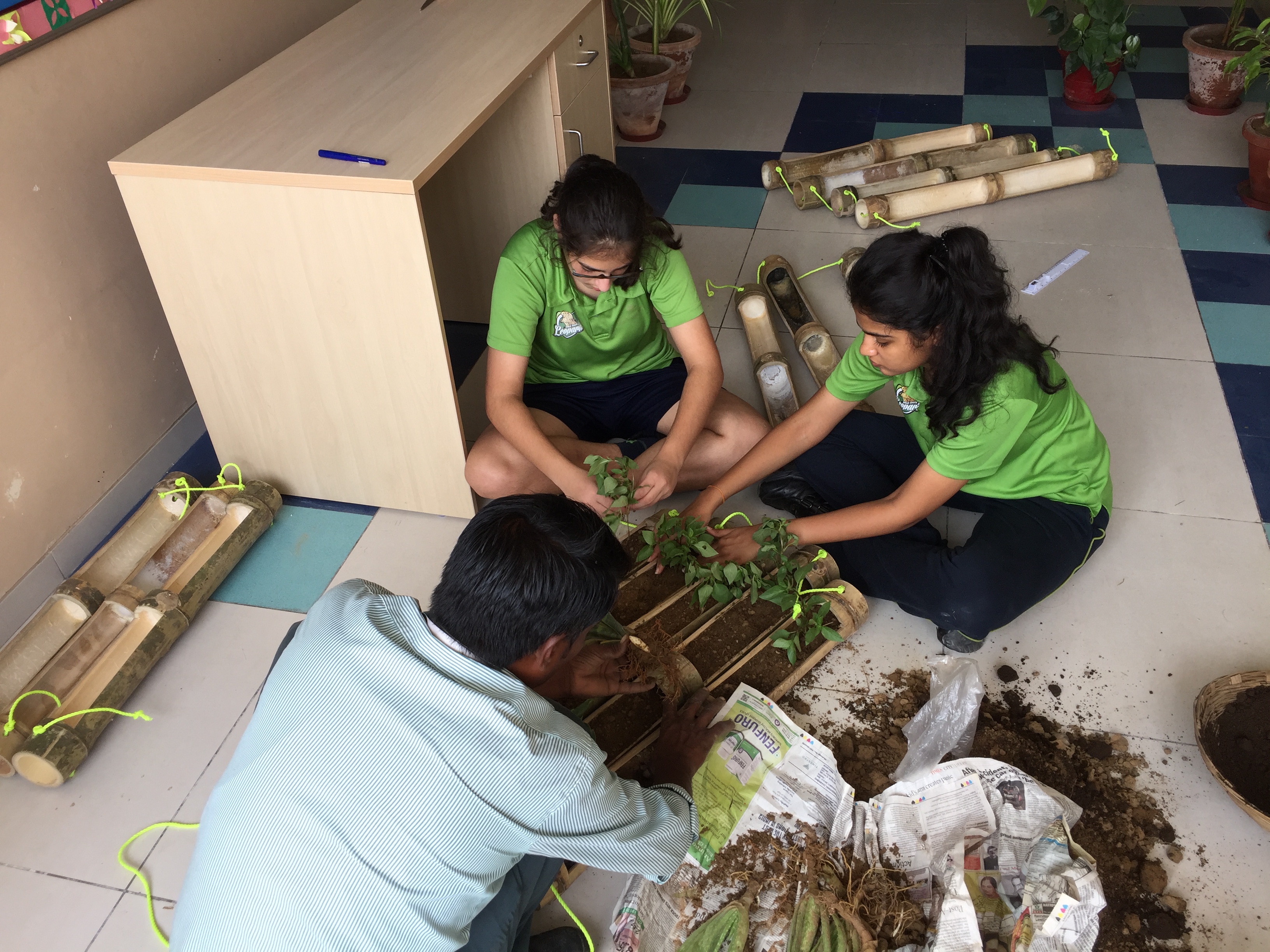
 Go Vert team using bamboo to grow trees. (Photo- City As Lab)
At Shiv Nadar Public School in Gurugram, almost every classroom has an air purifier installed to prevent children from the rising air pollution in Delhi. At school, children of all ages, come wearing masks, equipped to protect themselves from breathing impure air.
These alarming and urgent concerns rattled four Class 12 students- Palak Modi, Disha Zatchi, Soumya Juneja and Ira Sidhu who took on the challenge to find a solution to this pressing problem. They started by applying a simple, cost-effective and sustainable solution – Go Vert, to reduce air pollution in their school premises.
This #LittleHumans series is in collaboration with City As Lab, an organization that promotes original research and inquiry amongst India’s students, in a systematic, supportive manner, stemming from the belief that there is a researcher in every child.
Read to know more about their insightful findings.
Q) Why did you want to take on a research study?
A: Our teachers told us about City As Lab and asked if we’d like to participate in a year-long research study. The idea to conduct a study in real time, come up with a problem statement and find solutions to the problems around us, seemed interesting. Some of us in the group are trained Kathak dancers and often spend are free time rehearsing, this was something different for us to take on, besides studying.
Q) What is the research topic you explored? How did you arrive at Go Vert as the study topic?
A: Air, the most important element to sustain life on Earth, is now getting severely polluted. This also has adverse effects on our health. We wanted to see how natural purifiers helped to reduce air pollution, and therefore took on the task of testing the effectiveness of plants over air purifiers in our immediate surroundings i.e our school campus.
There were multiple reasons we chose to research this topic. Firstly, it is not something that is on everyone’s agenda. The situation has become so alarming that most places in our school have air purifiers installed. However, despite the air purifiers, children would come wearing a mask and not go to a playground to play. They were scared of the pollution outside the classroom environment. This was disturbing to know and see. Another reason to take on this topic was because Disha from our group has asthma and she too would wear a mask to school. She had to shout to make her own voice heard as most times the other person was unable to hear what she was saying. I mean, this does not even make sense, right?
All of these reasons gave us a strong push to choose this topic over any other.
Q) Can you tell us more about Go Vert and why you chose the name?
A: Vert means green in French. So, the literal translation was Go Green and hence we came up with the name “Go Vert”. If you see, Vert is also the prefix of the word vertical. Since we were planting vertical vegetation in our school, it fit perfectly!
Q) In the introduction of the abstract you mentioned “Sooner or later, we shall have to realise the earth has rights too, to live in a safer environment, to be able to breath.” Please elaborate.
A: We consider earth as ‘being’ with equal rights, just as we humans have. We share resources with Earth and we have to give respect to the earth for the natural resources it provides for us. The Earth is our home. We should not exploit Earth or our future generation and keep over-using or ill-treating its resources.
Q) If the earth has rights, does that mean you have rights as a citizen too? And do you have rights as a child?
A: Yes, we too have rights as citizens and as children! We think the Right to Education, Right to Survival, Right to Protection from harm and abuse, Right to Participation, Freedom of Expression are some of the basic rights of children.
Underlying all of these is the right to be heard and ensure we are protected and this is why we live, right?
Q) Tell us about the experience of studying air quality? What did your findings tell you?
A: For starters, we first understood what Air Quality Index (AQI) meant. For instance, if the AQI of Delhi reached 250, what does this actually mean? We kept reading these figures in the media. How polluted is the air? We went back to basics and also got Air Quality Monitors to study the AQI in our school. We understood that AQI keeps changing depending on the weather and other external factors such as proximity of factories and chemicals around us. That in itself was an eye-opener.
Q) We all know that plants act as natural air purifiers. ‘Grow more plants’ is what we have been hearing and yet it isn’t achieved entirely. What did your study indicate?
A: It is time to go back to the basics! One of the easiest things is to put up a machine instead of using what is naturally available to us. What we need right now is cost effective, and sustainable solutions by using the natural resources already available to us. Our study told us that plants act as natural purifiers and it will only benefit us if we went back to the natural resources available to us to solve pressing issues.
Q) What difference did you find in the air quality level after you placed plants in your school?
A: For about two months, we planted trees in our school and found a drastic change in the level of AQI. We used Air Quality Monitors to test the same. We saw a 15-20 % reduction in the PM level, an air pollutant found in the air. With monitoring the AQI, we concluded that plants help reduce the AQI level drastically.
Q) Have you shared your findings with your friends, school, and neighbourhood?
A: Yes, we have been passionately working on the project and love having conversations, spreading awareness and asking everyone for their feedback. We feel that it is a collective responsibility to protect the environment around us so that our future generations will be able to have cleaner air.
Q) Do you know about the odd-even scheme that the Government of Delhi rolled out as a way to reduce air pollution in the city? What do you know about its success and failure?
A: We think it is a controversial scheme because in a vast and diverse country like India the odd even-scheme cannot run in the long run. One cannot prevent vehicles from being on the road. Even though the scheme did better in the first phase, the AQI did not reduce drastically in the next round. Our research told us that there are many parameters by which the AQI can show us a change in the levels.
Q) What did you learn about plants, the environment, air pollution, and damage to the climate, through this research?
A: We always underestimated the capacity or ability of plants. Besides producing oxygen, they not only improve the air quality but also have some therapeutic effects on the person who is occupying the room. It pacifies the mood, calms and relaxes people. Some plants also help to keep insects away. Some of the plants we put in school were the Snake Plant, Aloe Vera, Spider Plant, Peace Lily , Lemon Grass, and Basil. For instance, the snake plant gives us oxygen 24/7. It is a natural purifier, Basil and Lemon Grass keeps ants, flies and mosquitoes away.
Q) Is climate change and its effects a topic of conversation at school, at home or with your friends?
A: Yes. Now, after our research study, we do that all the time! After planting vertical vegetation in the school, we also have got the same plants at our home. In a city like Bangalore, vertical vegetation is popular and we hope to take this to apartments in Delhi too. We also keep discussing how to take this project ahead and keep sharing with our parents and friends on our future plans.
Q) What were some of the interesting things you learnt that you never knew before?
A: There were so many interesting things. We never knew what terms such as AQI actually meant. We did not even know how to measure AQI. Now, we have a deeper understanding of how this works and it was fascinating to become aware of the air we breathe!
Q) What was difficult about this research?
A: Air pollution is a topic not everyone wants to dig deeper into. To choose this topic, convince everyone why it is important, and to understand the hazards of air pollution remained a challenge.
Q) A WHO report in 2014 listed 10 of the 15 most polluted cities in the world, in India…No 1 being Delhi. It also highlighted that children were at the greatest risk. Did you know that?
A: Yes, we are aware of the WHO report that said Delhi was the No. 1 polluted city in the world, which is why there is an urgent need to work on effective solutions. We are aware of the risks children face. We at least got a chance to be outdoors and play in the open, but we feel bad for children younger than us, who prefer being indoors than outdoors.
Q) Your report stated that children could not go out to play in playgrounds because of air pollution. How did you feel about that?
A: A large part of our childhood revolves around play and it was sad for us to see children sitting indoors, listening to music than going out. We don’t think anyone should have a childhood like that!
Q) If you had to appeal to the country/ world leaders (on behalf of other children too) to ensure your right to clean air was fulfilled, what would you say to them?
A: We think the UN is doing a good job while talking about Climate Crisis and air pollution. However, the need of the hour in India is to use sustainable long term solutions which are cost effective. We’d like to support them and collaborate with the government on this!
We strongly feel that making bullet trains by cutting down trees may lead to development, but it will never create a balance in the environment or produce clean air. The government needs to relook at the things it does in the name of development. Simple things like planting trees in big volumes can go a long way in protecting the environment.
Q) What are you plans/ actions after the research? How are you going to share your findings with people outside of school so that air pollution can reduce in your city? Tell us your ideas.
A: We are in talks with different NGOs and would like to work with them to provide eco-friendly solutions. This will also help us take our work further as we also want to create green spaces in apartments and societies in Delhi and Gurugram. We shall also be participating in the Google Science Fair which will give our research a big boast! Planting a tree is a simple thing and can go a long way.
Little Humans is a volunteer driven photo project based on the belief that the littlest people have the biggest stories to tell. You can contribute too. Share a story, volunteer with us or simply leave a comment on our blog. For more such stories, follow us on Facebook and Instagram.