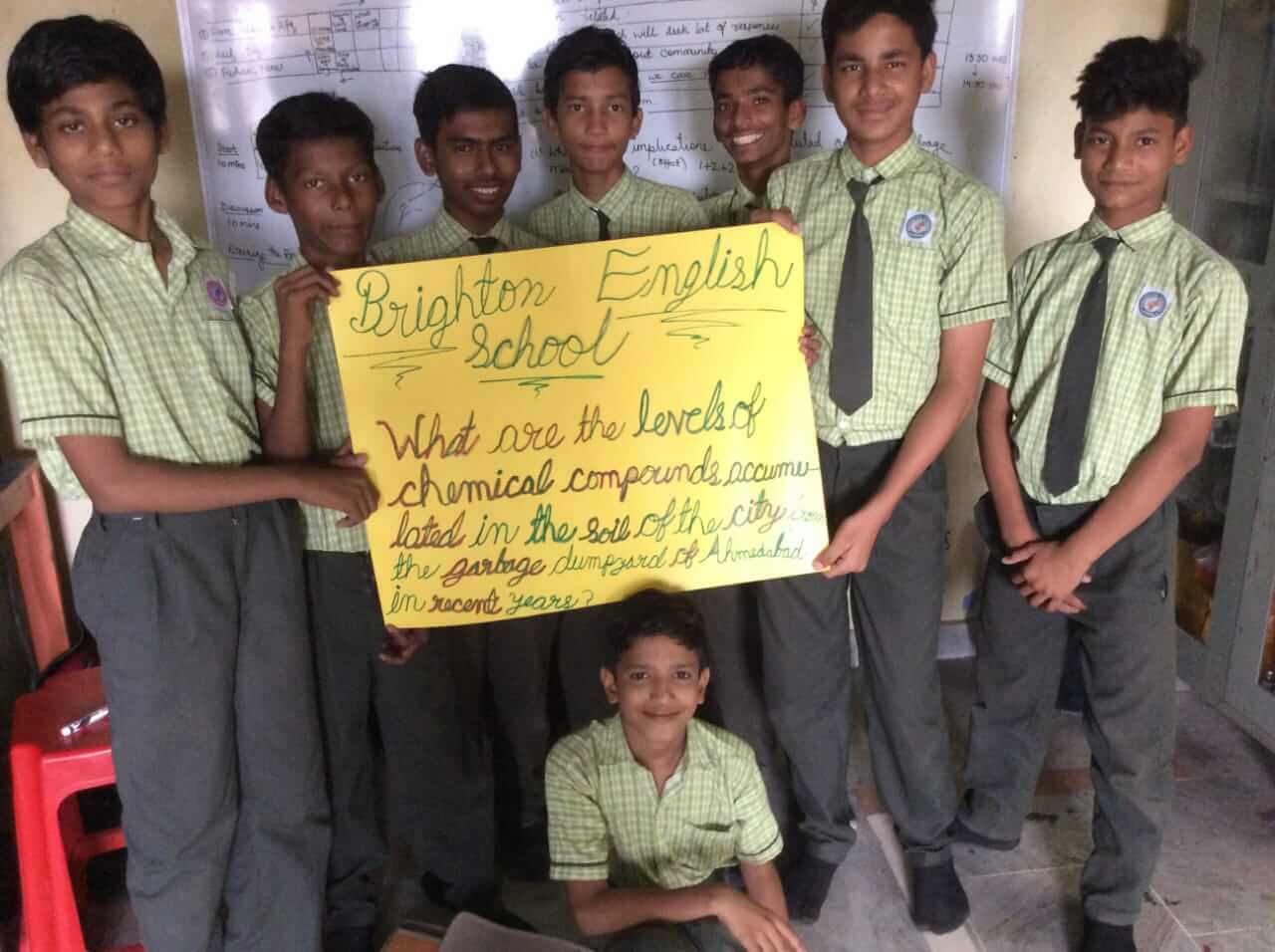
 Children at Brighton English School getting ready for their presentation. (Photo- Shahnawaz, TFI fellow)
The Pirana dumping ground, spread over 84 hectares has been Ahmedabad’s major dumping ground since 1982. The landfill comprises three 75-feet massive mounds of garbage. People living in close proximity of this dumping ground are constantly breathing polluted air, living amidst toxic waste and therefore surrounded by hazardous conditions. Children residing at the dump are left with no open spaces to play and do not attend school as they end up working at the dumping ground to assist their families in making a living.
These were some of the pressing concerns with which eighth 12-year-old students in Ahmedabad, living in close proximity to the dumping ground decided to understand the depth and scale of problems associated with this place.
Mentored by Shahnawaz, a former Teach For India fellow, these boys also applied concepts of design thinking to their research project, are were invited by the Indian Institute Of Management, Ahmedabad to share how design thinking could be used as a problem-solving tool.
This #LittleHumans series is in collaboration with City As Lab, an organization that promotes original research and inquiry amongst India’s students, in a systematic, supportive manner, stemming from the belief that there is a researcher in every child.
Read to know more about their insightful findings.
Q) What is this research topic you chose?
A: We wanted to understand the contamination of soil at the dumping ground, the level of pollution and link it to the health hazards people face while living in the vicinity There were many layers to this topic- first the garbage itself, then the health hazards, then the mafia that works here along with the rag pickers who get income from working at the dumping grounds. It was important to understand the level of contamination before we conducted surveys with people.
Q) Why did you pick this topic?
A: All of us have grown up in this area and that’s why this topic is close to our heart. Often, people have normalised living around the dumping ground and remain ignorant of its adverse effects. We discussed three to four topics before we finalised researching on the Pinara dumping ground.
Q) The findings in your paper say that 53 % of the people who live within a 1 km radius of the dumping ground went to visit the doctor 3 to 5 times in a month. Can you tell us more about these findings?
A: Yes, that’s correct. We conducted a survey with 250 households living in the community and asked several questions around their health. Most children visited the doctor 3 to 5 times in a month and were facing respiratory diseases. Health concerns such as cold, cough, fever and respiratory diseases were common with people living at the dump yard.
Q) In the abstract you mentioned the complex issues of the dumping garbage and the need to make a mind map to prioritise which issue to focus on. Can you tell us more about the process of creating this mind map?
A: We wrote the pros and cons of all the issues around the garbage dump such as the Garbage Mountain, health hazards, children not attending school, the role of the government etc. Eventually, we started to prioritise the issues and once that was done, it was easier to find a connection between all of the sub topics. This helped us to design the structure and the approach to the entire study. For the survey, we used the field stage that helped us to come up with our problem statement.
Q) What concerned you the most from the findings?
A: Everything was a concern! The garbage mountain that was piling up was nothing more than toxic waste which added to the health hazards. The sad part is that not everyone can afford to move to a better and cleaner environment. Some of us know that the garbage dump is a problem and yet we have normalised it all.
Q) Can you share some anecdotes/stories of what people who lived close to the dumping ground had to say? What about the children in the neighbourhood community?
A: People were curious to know why we wanted to learn about the garbage dump and how our research will help them. A few people from the community were anxious and did not want to sign a consent form for the survey, others did not take us seriously and yet there were families who were keen to look for solutions.
We found that children were not attending school, would sometimes work at the dumping ground as rag pickers, and also suffered from health ailments. This made us sad. Why should children go through this?
Q) What actions did you come up with to reduce the dumping of garbage?
A: We suggested that all kinds of waste be segregated – plastic waste, wet and dry waste, industrial waste and medical waste. We also think that the waste that is being dumped needs to move in a more systematic manner to different areas in smaller pockets rather than being dumped at one place.
Q) What did you find in terms of living conditions of children at the dumping ground?
A: Children do not even have a playground and they use the garbage dump, the only place available to them to play sports. Now you only tell us, how can this be a happy place for any child? We all like to play in the open, but here, we do not have any such space. We also came across children who did not attend school due to the poor quality of education. Even health conditions of children were not so good. We also found that children often complained of fever, headaches and cold and respiratory diseases.
Q) One of Asia’s largest dumping grounds is in Mumbai, Deonar. The Human Development Index(HDI) is the lowest. 50 % of the children are malnourished and live in hazardous circumstances. Did you know about this?
A: We do not know about the dumping ground in Mumbai. However, we did come across malnutrition in the dumping ground here. Children as young as 5 were weak and we could even see their bones. We also came across children who had rashes all over their bodies and others who were born with deformities. For us, these health hazards were alarming.
Q) Many children work at the dumping grounds and are unable to go to schools. What do you think is a solution to enable children to attend school?
A: Why can’t the rich people contribute to schools in slum communities so that more children feel like attending the school? The government should balance the facilities in the public and private schools. Tell me, even when children attend school, how many of them understand what the teacher is saying?
We believe, if children are provided with a happy environment, everyone will automatically feel like attending school. We also know that education is the right of every child irrespective of how much their family earns.
Q) Have you shared your findings with your peers, neighbourhood and the community? What did they have to say?
A: We got mixed response from people from the neighbourhood and community. Some of them were curious; others did not take us seriously. We are children after all, right? However, we were appreciated by our school for undertaking this research. For us, the best part was when we presented the findings to our school teachers and they encouraged us to dig deeper. Our teachers took the survey findings to their families and they gave us positive feedback. We are so happy!
Q) What’s next? How do you plan to take your research findings ahead?
A: We want to hold a press conference so that the media covers the issue of the dumping ground and hazardous waste, with seriousness. We believe this will also put pressure on the government. You know, the government talks about Swachh Bharat Abhiyan and a clean India, but why doesn’t the government first clean the heaps of dump? We shall be looking at filling a Public Interest Litigation to know more about the violations of rules for having the dumping ground close to the houses of people.
Little Humans is a volunteer driven photo project based on the belief that the littlest people have the biggest stories to tell. You can contribute too. Share a story, volunteer with us or simply leave a comment on our blog. For more such stories, follow us on Facebook and Instagram.