“If one man can destroy everything, why can’t one girl change it?”
― Malala Yousafzai
Malala stands for many things- Grit, Determination, Courage with which she fought for her rights and rights of millions of girls to get access to education. In more ways than one, she has become unanimous when it comes to Education and Activism.
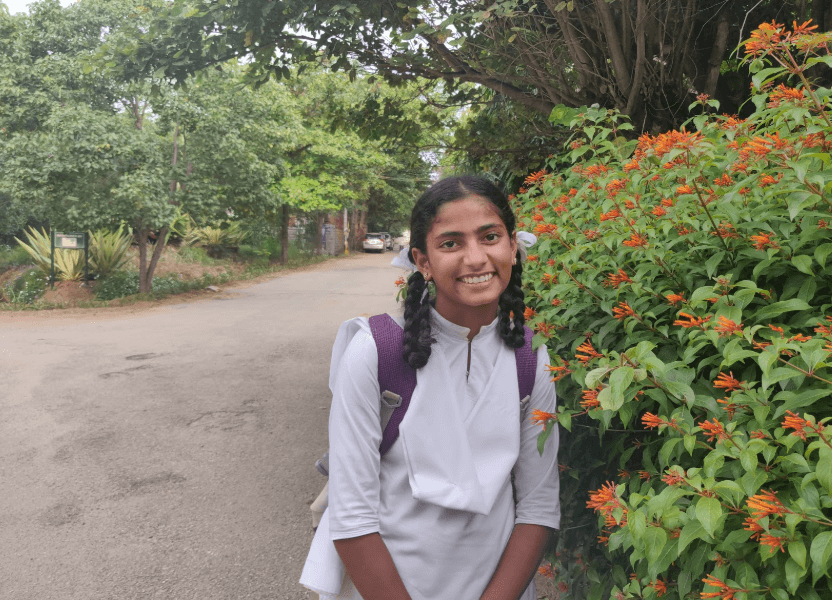
In this two-part story, we begin with a conversation with the 13-year-old Bhargavi from Bangalore, who faced gender discriminated in her own house. But instead of getting discouraged, Bhargavi took this in her stride, began reading on gender inequality when she was a little girl of 10. On every recess break, a time sacred for children, she would open the blue door of her classroom, invite young girls to talk about what gender and discrimination meant to them. Little did she know that she and all other girls would be able to reflect and own up their own stories. Bhargavi’s story is no less than inspiration. Come, read what this Little Human has to share with us.
1.What are three things you love about going to school?
I love going to school and meeting my friends because when I see them, I feel a positive energy and that brings a smile on my face. When I am back from school, I feel like I’ve learnt something – whether that be a subject, behaviour or another experience. I also enjoy working with my classmates, it makes me so happy!
2. Why did you decide to begin work on gender inequality? What triggered you?
I had some problems in my family with gender inequality where I used to feel I am discriminated against because I am a girl. As I grew up, I noticed that my relatives and everyone started pointing out that my mother has two girls and no son, and that was not a good thing. I used to believe that this is how the world works, but when I came to Bangalore from my hometown Shivamogga and became a part of TFI class, I started realizing this was not true.
3. We hear you are working on gender inequality with your peers in school? Can you tell us more about it? How did your journey begin?
When I joined the Teach for India (TFI) programme, I was introduced to KER (Kid’s Education Revolution), an organization where educators and children are working towards getting a good education for students. Here, I observed the work that included gender inequality or creating a safe space for students. I recognized the problem in gender inequality and realised the inequalities of the world. I knew I wanted to do something about it but I didn’t know how to, but I asked myself ‘What are you doing about this Bhargavi?!’
I thought that I should start by getting some knowledge about gender inequality. A TFI fellow helped me by sending me articles on gender inequality. I thought of conducting sessions because through the group with KER I was motivated by how everyone shared their stories. I started hosting sessions in 7th grade but only a few people used to come up to me and tell me their problems.
Through this, I learnt that people like my age didn’t know that this was even a problem, and hearing experiences from my peers made me more educated about the problem. I started taking sessions to raise awareness. The sessions started by telling them what gender inequality is. I wanted their voice to be heard in a small group. I learnt that when we have a pain that we express to someone, it calms us down. I realised that people struggled to open-up in group settings and I started talking to everyone personally, which was effective for children to share with me. In class 8th I moved to another school and as I was new they were not comfortable, so talking to people one-on-one was better.
4.What does gender inequality mean to you? What inspires you?
I was discriminated from my family but I like to think about this positively. I recognise that everyone in this world reacts to things differently and take their own time, so instead of taking revenge on them, I will stay with them because I know that all people react based on their experiences. The most powerful weapon we have for change is love – we should understand their problem. If we take off the ‘in’ from inequality, if we work together one day we’ll get there.
5. What is the one story that has touched you the most? Share a proud moment in your journey with us.
A story that touched my heart and moved me was of my friend Shilpa’s story. She has two brothers and her parents enrolled them to an expensive school, but Shilpa was sent to a government school. She wanted to do things but they didn’t allow her. For the boys, parents showed a ken interest, but she was not allowed to do new things.
My proudest moment would be when I joined my new school in 8th grade, at the beginning of the year my peers didn’t understand the purpose of these sessions. However, by the end of the year, they realised and recognized that they were facing gender inequality in their own lives too.
6. What motivated you to initiate that first conversation about gender inequality with your peers?
When I moved to a different school it wasn’t easy for me to communicate with my peers so instead, I used to go to them personally if they were feeling sad and would ask them if they were facing any problem. Amongst other problems, gender inequality was also a big problem that was apparent which motivated me to continue talking about it.
7. What are some challenges you have faced whilst having these discussions with your classmates?
Government teachers never used to help me with this as they themselves believed in gender inequality and would focus on academics. I realised it is hard for me to change their mindsets as some of them would even oppose me. For example, they would have questions about why girls need to part in certain activities such as sports. My school principal wouldn’t give me permission to do certain things and said, “Do you think you’re special here?’’ I used to politely listen to them when my teachers questioned me, ‘Why are you taking these sessions?’ However, I didn’t take their advice or them seriously. If I am unable to do something about it right now, I don’t let that stop me. I will continue working on gender inequality in whatever way I can.
8. What inspires you to initiate conversations on gender inequality? Who is your a role model?
My role model is a staff member I met in 2017, Raghini Ma’am. She used to face the same issues as me and gave me some advice, “If you recognise something such as a problem, don’t just keep it within you. Share your ideas with others. “
9. What is your dream? What do you want to do when you grow up?
I want to become a gynaecologist as that was my grandfather’s dream who believed in me a lot. My friend and I want to build a school where children are able to learn from their practical experiences because I question the idea of learning from textbooks and simply writing answers based on other people’s experiences of the world – is it really relevant to our life? I’m not sure how I’ll be able to do all of that yet.
10.What advice would you like to give to girls and boys your age?
Dear teenagers, we are here in this beautiful world to make the world even more beautiful. Let’s try to work on that instead of discriminating on gender, colour, teasing etc. Let’s do something productive for our future.
11. And advice you’d like to parents, teachers and people from your community?
I keep seeing in India where Hindus and Muslims fight and I think – Dear people, instead of pointing at something or someone or blaming why can’t you educate yourself about the idea first? And try to solve it in a kind way. Also, this COVID-19 might not be solved tomorrow, but one day we’re going to solve this problem and come back to our own life.
12. Due to Covid-19, inequality in education has increased especially when not everyone can afford online education. What’s your take on it?
I try to think from all perspectives. For example, if I’m a Headmistress/Headmaster (HM), what would I have done? I would be confused about what’s more important, education important or a child’s life. I think about how in a low-income government school what can the HM or teacher do? They can’t call children to school, they can’t go to their houses, they don’t have internet access. My cousins are in 1st and 3rd standard, they don’t have their own phone. The school is going to send homework to their home. In my class there are 41 students, 20 of them are not part of online classes. How are we going to face 10th? So, parents and children should take responsibility of themselves and their future.
I think corruption is the biggest reason here. Like the government they should question, where should we spend our money? After Covid-19 is over, let’s work hard together to get a great reward.
13. How has education changed your life and the lives of others around you? Can you share instances with us?
Education has allowed me to have a lot of new experiences. For example, I have learnt that people will oppose you in life. What you can do is hear them, but you should ask your soul do you really have to apply their advice in your life? Education has taught me about putting in the effort and the reward that we get, which both have a really good connection. If I’ve put a lot of effort into my project and I wasn’t rewarded, I wouldn’t quit. The way I approach it is by thinking, ‘Let me change my idea.’ It’s about being gripped. I also really enjoy learning from my peers. My biggest achievement in life isn’t my school-academic certificate or my artwork. For me, it is nurturing and raising this family into this exceptional bond that we have today. What makes me immensely proud is how we support each other to reach our individual goals. After a day’s work of looking after the house and working on paintings with customers, it makes me so relieved that I can feel at peace with my family at the end of the day- whom I’m proud to say are my best friends.
14. What are your future plans? How do you want to take your work on gender inequality ahead?
I am already working on a performance project for all of Bangalore. In Pune, some kids did The Greatest Show on Earth which was a drama where they expressed themselves with real-life stories of students and performed it in front of people. The project I am working on is called, ‘Namma [Our] Voice’ and is about bringing children’s voices to light. I am working with my friend and just today we sent emails to all TFI fellows to spread this opportunity to students. 15 students will be selected and online sessions will begin. We are looking for students who are facing some problems but not able to find solutions for it. We are going to send out worksheets for people who don’t have access to the internet but are very interested. At one point in time, I was also a student like that and I am going to share my story too. Until now I have worked with children but now I will work with everyone. HM’s, stakeholders and other adults will all be attending. I am excited about new experiences!