Often, when organisations work with communities, children and young people, we hear the voices of girls and women. However, to create an ecosystem where child rights and protection is a shared responsibility, we need the participation of men and boys too. While we may all know that no one size fits all, how different is it to work with men and boys really? What are some of the challenges when it comes to working with them?
What are some of the strategies or different approaches that organisations can adopt to engage men and boys? Can we talk about gender equality and ignore our work and boys?
Too many questions, let’s explore to find the answers together.
In this interview, we speak with the Equal Community Foundation (ECF), an organisation whose mission is to raise every boy in India to become gender equitable. Since 2009, ECF has been implementing a structured gender-transformative programme for adolescent boys in low-income communities.
Come, let’s hear a new perspective on gender equality and the experience of working with boys from ECF.
1. Your organisation takes a different approach to work on gender equality and works with young boys? What led you to work with young boys?
Gender inequality stems from patriarchy, which has penetrated virtually every social system – be it religion, nationality, ethnicity, caste, class, etc. Historically, gender equality has been seen as a ‘women’s issue’ and has also erroneously been understood as a ‘men’ vs. ‘women’ issue. Generally speaking, it has always been a challenge to make gender equality a priority for any community, irrespective of caste, class or creed, especially when you are trying to engage boys in the conversation to make them a part of the solution.
Our organisation focuses on engaging boys in a structured process to enable them to identify, challenge and change gender norms and we have found that once we engage boys in this process and they learn about and reflect on concepts such as human rights and gender they are able to identify discrimination and violence easily, which helps them transform their own
attitudes and behaviours. So while it is challenging to initiate these types of programmes, as the impact becomes evident the community starts to support the programme.
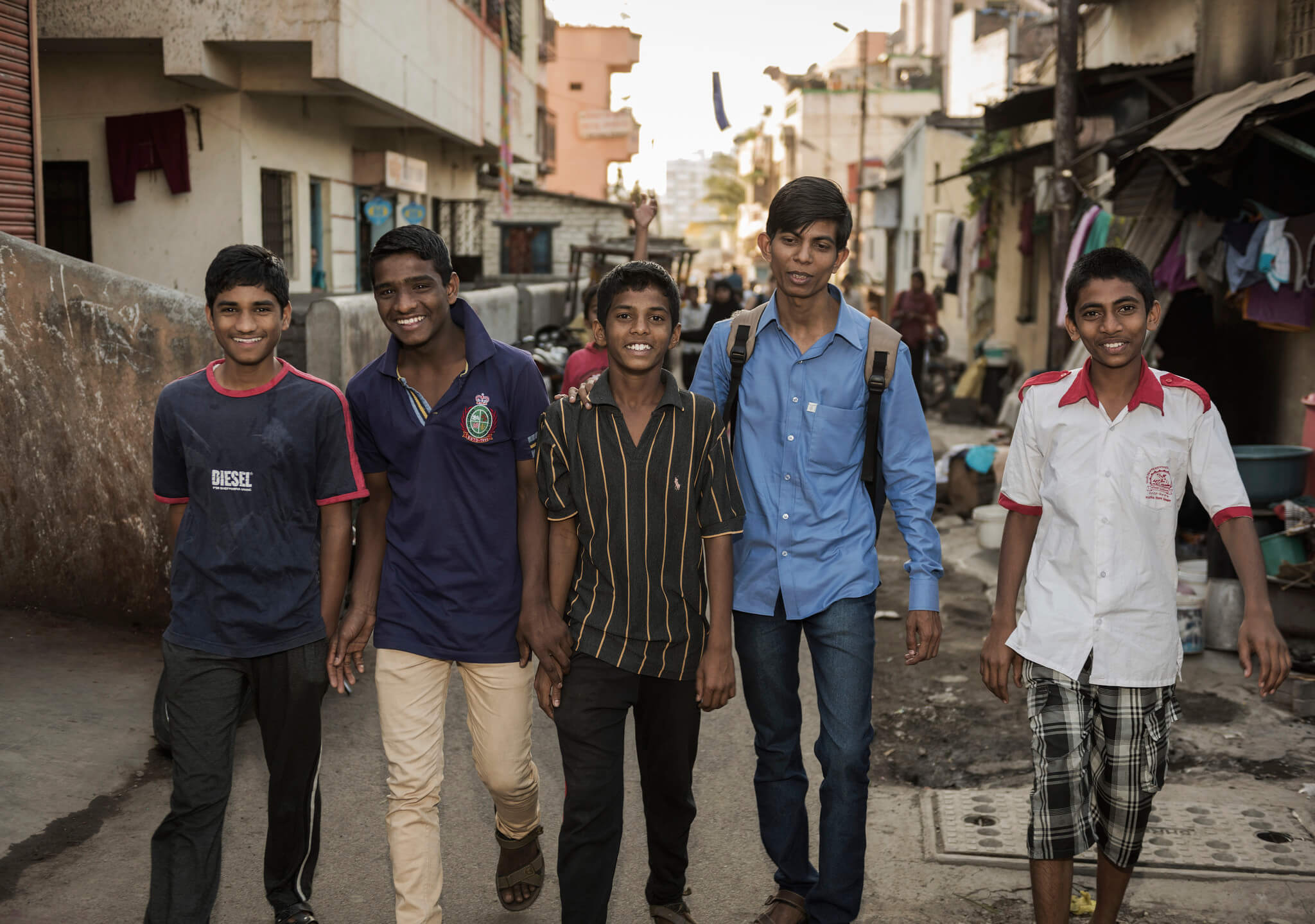
We have been implementing a structured gender-transformative programme for adolescent boys in low-income communities in Pune since 2009. We have found that boys respond extremely well to the human rights approach and as their critical thinking and communication skills develop over the course of the programme they develop the courage and ability to transform their behaviour. Almost immediately after the start of the programme, boys begin to share household chores, they advocate for the sister’s right to education, their communication with family members improves and they tend to focus harder on their education and spend less time loitering in the community. While these are some individual-level changes we also find that their interaction with girls in the community changes, they refrain from engaging in street sexual harassment, are able to create safe spaces and promote positive and healthy interactions with girls around them. At a community level, we have seen some of our alumni take actions against child marriages, undertake awareness campaigns against addiction and menstrual taboos, intervene in domestic violence and also actively take on covid-relief work during the pandemic.
2. What are some of the challenges you have faced in the work that you do? How have you addressed these challenges?
Some key lessons we have learnt along the way have come to form the pillars of our programming with adolescent boys. These pillars form the basis of our programme structure, design and delivery.
First, it is important to believe that men and boys can change and want to change. They are not naturally inclined to violent and discriminatory behaviour.
Second, not all men are a part of the problem, but all men can be a part of the solution. Socialisation into patriarchal gender norms leads some boys to grow up to be violent and discriminatory. By promoting socialisation into equitable norms and behaviour from a young age, we can ensure that every boy has the opportunity to grow up to be non-violent and non-discriminatory.
Third, our programmes should be rooted in the Human Rights Approach. It is important to develop an understanding that human rights are the basic rights that every person needs in order to live a fulfilling life and it is our duty to stand up for each other’s human rights. It is also important to create an understanding that women and girls need to be seen as human beings first, not as mothers or sisters or wives or daughters. Irrespective of their relationship with us, they are human beings who are entitled to human rights.
Fourth, we refer to our participants as allies, not perpetrators or champions or heroes. As we work towards gender equality, we need to ensure that we are not promoting the idea of boys ‘protecting women’ or ‘granting them their rights’ or ‘helping women’ by challenging gender norms.
Fifth, our programmes should also cater to the needs of men and boys. They should create safe spaces for them to reflect on the impact of gender norms on their lives. Gender equality is not just a women’s issue. It affects people of all genders including men and it is important to create spaces for men and boys to reflect on their own experiences related to notions of masculinity and gender norms, and their vision for how gender equality can benefit them as individuals.
Sixth, our programmes should complement the programmes for women and girls and not replace them and they should incorporate the voices of women and girls. Programmes that build awareness, agency and equity among women and girls are critical and programmes for men and boys should complement these programmes so as to minimize backlash and foster an enabling environment for women to exercise their agency. Programming for men and boys should promote collaboration and dialogue through the inclusion of the voices of women and girls.
Finally, programmes should foster critical thinking skills and should be rooted in adult learning principles and the participatory approach. We should develop activities that foster critical thinking, problem-solving and communication skills so that participants can reason and arrive at solutions and action plans independently. We should respect the lived experiences of our participants and create a platform for them to reflect on those experiences and recognise that our role is not to instruct but to facilitate a participatory process and discussion.
3. Often, we see organisations that work with communities have been able to successfully work with women and girls. However, many organisations have not been able to include men and boys into the discourse, to create a shift in attitude and behaviours? What do you think are the gaps? Why are less than 5 % of organisations that believe in gender equity working with men and boys?
Gender equality is widely considered to be a women’s issue. Gender equality initiatives are often perceived as efforts that will not benefit or negatively impact men; “Men see gender justice and full, meaningful gender integration as a threat to their status and conferred privilege. Men feel that they have little to gain and everything to lose. Members of any privileged group will always work to maintain that privilege”.
However, men and boys face gender-specific issues under patriarchal structures as well as women and girls, and men and boys have hence been shown to benefit from gender equity. In more gender-equitable societies “men are half as likely to be depressed, less likely to commit suicide, have around a 40% smaller risk of dying a violent death and even suffer less from chronic back pain. Adolescent boys in those countries have fewer psychosomatic complaints and are more likely to use contraceptives”.
Adolescence, in particular, is “a period of opportunity when boys and girls begin to form their opinions, ideas, and beliefs – including around gender roles and sexuality”. It is hence essential to engage boys in a formative period in their lives.
4. What are some of the issues faced by men and boys? Are they different from what young girls and women face?
Men and boys are also victims of patriarchy. Being in a patriarchal society, they are expected to behave in a certain way. From an early age, boys are taught not to cry, as that is portrayed to be ‘a sign of weakness’; boys are not allowed to play with dolls, as it is not considered to be ‘manly’; boys are expected to be strong, active and dominant. If a boy does not fit in these boxes set by the social standards, he is looked down upon, made fun of and is treated as an outcast Hence, from the time when boys develop certain emotions, they have to keep them within and cannot express their feelings. These remain a trait among men when they grow as adults and they cannot express an emotion that is ‘thought to be weaker’ or ‘less manly’, like crying, caring, talking their heart out to others, etc. Hence, the only way they bring about such emotions is by being ‘masculine’ and ‘protective’, the two major traits that society has associated with men. The pent-up emotions are such that they can also bring out the violent side of a man too, where the sole emotion is anger and violence. The burden on young men to earn for their families is tremendous. During the pandemic, many adolescent boys have dropped out of school and started a job to support their families financially. This is expected out of them, as they are ‘males’. Adult male members too take the pressure of being the ‘provider’ for their families, and this pressure is so strong that at times if their partners earn more than them, it affects their ‘male- ego’, which is a product of the patriarchal society.
5. How do young men and boys perceive violence? How can they be part of the solution rather than violence? How can men and boys play a role in Ending Violence Against Children?
Like most people, violence is something that young men and boys have also seen around them most of the time. From early childhood, they have seen violence as the answer to many troubles and it is often perceived as ‘an acceptable gesture’ to solve problems or teach one a lesson. Eg: In our sessions, many boys feel that it is completely fine if teachers beat students or if elders beat children. These are the same boys who do not support domestic violence.
Again, speaking of different forms of violence, while young boys do not accept domestic violence or will not be perpetrators of violence, they tend to remain bystanders in many cases, especially if the violence is in a private space. Eg: In a hypothetical situation, where a woman is subjected to domestic violence (verbal or physical) by her husband, young boys do not support the action, but feel that as a family, they should not separate. They believe in discussing the matter and solving the issue, rather than taking an action to report the violence or move out of the relationship.
However, if the violence is taking place in a public space, these adolescent boys talk about taking action to mitigate the issue. Eg: In a hypothetical situation where a girl is being harassed and then blamed for wearing short clothes, most boys feel that the boys who harassed her should be punished and it is not the girl’s fault.
Men and boys can be taught to unlearn and relearn ways to tackle an issue, without resorting to violence, as the first answer. This needs to be taught to everyone at an early age, so that they can think of different solutions (like talking to an adult about a particular situation, discussing matters between each other, etc.), rather than being violent.