
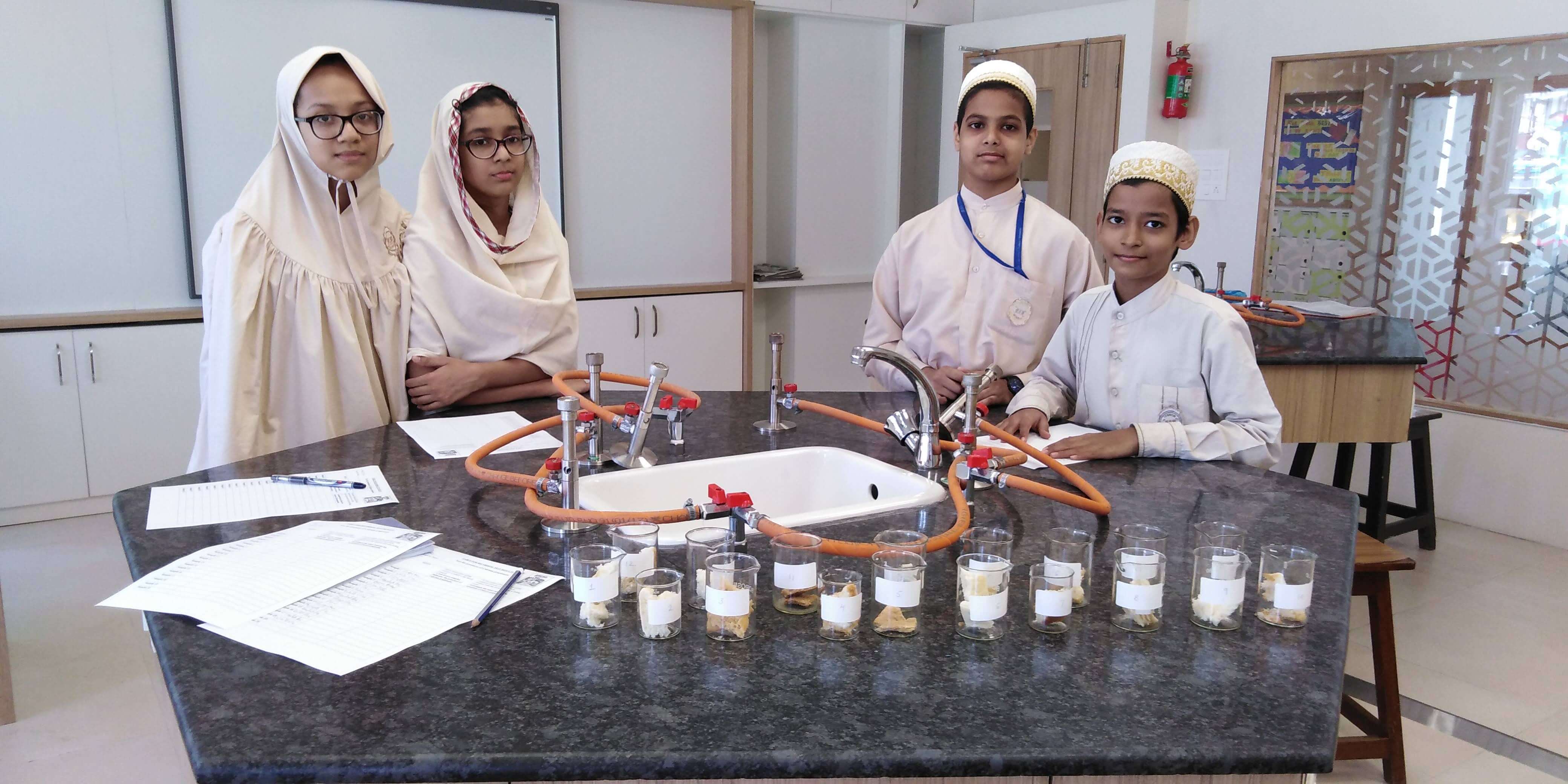
 Mariya, Mustufa, Huzefa and Zainab testing different breads at their school lab (Photo- City As Lab)
What if a group of children told us that eating bread has more harm than good? Mariya, Mustafa, Huzefa and Zainab from MSB International School in Mazgaon, Mumbai, took on the mandate of answering the question “How safe and healthy are the different varieties of bread available in the market?” It was by reading latest news and research papers, consuming bread themselves and understanding well that many people consume bread on a daily basis, that they decided to delve deeper into understanding the harmful effects of consuming bread and titled their project – “Bread Matters”.
The students took up this burning research topic and studied it for over nine months before drawing a conclusion on the same. They prepared their own research design, methodology, sampling and data collection procedure and also used their science laboratory to an informed argument on why we should stop consuming bread on a daily basis.
This #LittleHumans series is in collaboration with City As Lab, an organization that promotes original research and inquiry amongst India’s students, in a systematic, supportive manner, stemming from the belief that there is a researcher in every child.
Read to know more about their insightful findings.
Q) Tell is about the research you took on.
A: We chose a simple topic. We wanted to understand the harmful effects of bread, the use of chemicals and the health hazards bread can cause us and that’s why we took up this research study.
Q) Do you know about different forms of research? What was your approach towards the study?
A: We know the basic forms of research such as primary and secondary research, the importance of a hypothesis, testing the hypothesis and using different methods to collect the data and analyze it.
Our approach for the research was simple. We gathered 12 kinds of breads such as Pita Bread, Pizza Bread, White Bread, Wheat Bread, Pao from different bakeries around the city and tested the bread in our laboratory to study the chemical components in the bread. We used google forms and reached out to more than 88 families to understand their consumption patterns of bread. We also used secondary research to understand the components in bread that make it harmful for daily consumption.
Q) Why did you pick this topic?
A: We read news articles and research studies that said bread is unhealthy. So, we wanted to know why and if it was really true. We began to dig deeper to get more details. Everyone loves to consume bread, it is tasty, simple and easy to cook. However, we always had a doubt if bread was cooked with overuse of chemicals to increase its shelf life. This intrigued us we picked this research topic.
Q) What are the harmful effects of bread as per your study?
A: Bread uses preservatives such as Potassium Bromate used to bind the bread and strengthen the dough. In 1999, the International Agency on Research for Cancer declared that potassium bromate was a possible human carcinogen, which means that it can possibly cause cancer.
Calcium Propionate, another ingredient used in bread causes stomach ache, migraines and other behavioural changes such as irritability and mood swings.
Q) We read that you want to start a workshop on homemade breads. Do you have any plans to involve children in this?
A: Yes, the school has begun with a bakery class where every child is taught how to make homemade bread. It is healthy, organic, fresh and does not have preservatives. We took the study to our teachers and when they realised the harmful effect bread can cause, they themselves reduced the consumption of bread and have initiated bakery classes. At least 1000 children including families have reduced their consumption of bread.
Q) What do you plan to study/ research next? Tell us.
A: We will study the chemicals in biscuits because by now we know anything that uses preservatives to increase the shelf life is more damaging to our health and we would like to come up with alternatives for them.
Q) As home science students, what is your take on nutrition for children. What do you think constitutes a healthy meal for a child?
A: Eating a balanced diet is important. Fruits and vegetables are a must for a healthy mind and body. Every child should eat food with less use of preservatives and add a gluten free diet to their food. We do not know the preservatives used in packaged food anyway. We want to ensure that every child gets quality food and does not have to go through malnutrition or falling ill due to lack of a good diet. Instead of wasting food and consuming it from malls, we can save money, and contribute so that no child is left hungry.
Q) Do you have anything to say to the government or policy makers when it comes to nutrition, eating healthy for children?
A: The government must provide healthy food to every child. Instead of saying there are no children on the street; the government can go to the communities and slums where they live in large numbers. Every child requires a healthy diet and the government can promote healthy food in school canteens too.
Little Humans is a volunteer driven photo project based on the belief that the littlest people have the biggest stories to tell. You can contribute too. Share a story, volunteer with us or simply leave a comment on our blog. For more such stories, follow us on Facebook and Instagram.