“If one man can destroy everything, why can’t one girl change it?”
― Malala Yousafzai
Malala stands for many things- Grit, Determination, Courage with which she fought for her rights and rights of millions of girls to get access to education. In more ways than one, she has become unanimous when it comes to Education and Activism.
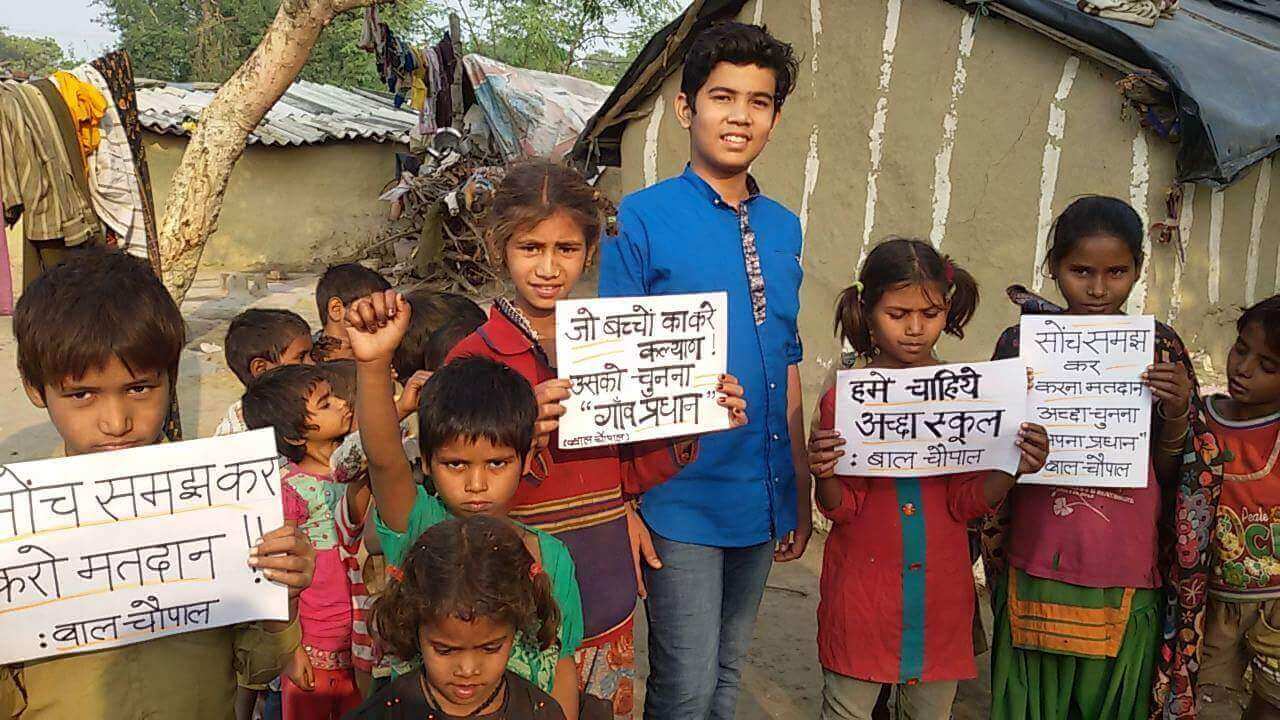
In the final #LittleMalalasOfIndia series, we had a conversation with 16-year-old Anand Mishra from Lucknow, a courageous boy who understood inequality and the gaps in the education system. However, with this awareness, he not only wanted to leverage his privilege but also act upon it. At the tender age of 8, he accidentally met a young boy from a low-income community and despite the little boy’s poverty, he was surprised to realise that they had more self-respect and dignity than he could have imagined. With his new observation, he decided to do something about it and began teaching everything he learnt at school. He pushed children from low-income communities and helped them realise education can change their lives. This young boy told them to never take no as an answer, that reflected from his own journey. Anand’s story is no less than inspiration. Come, read what this Little Human has to share with us.
To read, our first story in the series, click here.
1.What are three things you love about going to school?
Three things I love about the school are the environment, friends and education. I love the vibes as everyone around you knows you and it creates a safe place to share our thoughts, our wonderings and what we innovate.
2. Why did you decide to begin working towards education? What triggered you?
Around 8 years ago, when I was in grade 4, I went to Pune with my parents for a family vacation where we visited Jyotilinga of Mahadev. We went to the temple at around 8 pm and it was quite dark. There, I saw a boy and the condition and financial background of his family was visible by his clothes. Despite that, I noticed him and he was studying under a bulb. The arthi was about to begin and we went to take a bath and change our clothes. When we returned to attend the arthi I saw that that boy had also changed his clothes and was wearing a dhoti. When the arthi started, he started to sing along and his pronunciation in Sanskrit was so good that I was inspired. I learnt Sanskrit when I was 12 but at that time I was 8 and I knew nothing about Sanskrit. That little kid, who looked like a 7-year-old, was pronouncing so well. I was surprised and inspired and when we came out, I asked my father to give him some money so that he could buy some clothes for Diwali, as Diwali was approaching. My father offered a 500 rupee note, but what surprised me was the kid’s response, “I will not take money, it’s not mine.” Nowadays, we see lots of kids and people begging for money around traffic signals, but that little kid had so much self-esteem, which you don’t see in many people. Then the pujari came and told the kid to take the money and buy something he wants, but he replied, “If you really want to help me then just buy me some books and stationaries from a shop nearby.” And so we did.
As I sat back in my car, I looked back at the kid, who was waving at me. This picture stuck to my mind when I was returning home, I thought, I should do something for these kids. I’m going to such a great school because my parents can afford this school. Not everybody has the opportunity or the privilege to get this education and learn the great things about education. That’s why at that time when I was 8 the only thing I could do was share what I had learnt in my school, and so I created this social initiative ‘Bal Chaupal.’
Through this, I learnt that people like my age didn’t know that this was even a problem, and hearing experiences from my peers made me more educated about the problem. I started taking sessions to raise awareness. The sessions started by telling them what gender inequality is. I wanted their voice to be heard in a small group. I learnt that when we have a pain that we express to someone, it calms us down. I realised that people struggled to open-up in group settings and I started talking to everyone personally, which was effective for children to share with me. In class 8th I moved to another school and as I was new they were not comfortable, so talking to people one-on-one was better.
3. Tell us a little more about Bal Chaupal and your journey.
I began this journey on January 12, 2012, which is Indian Youth Day, on the birthday of Swami Vivekanand because he inspired me. It began by teaching kids from low-income communities who came for work near my area. Initially, I taught them what I knew “abcd, addition, subtraction, multiplication etc”. Gradually, Bal Chaupal started to grow as people who wanted to support the initiative joined over time. I also grew and learnt more things at school that I further taught them. I regularly taught in a slum near my home on all holidays and weekends. I went to different slums and villages near my city and conducted pep talks and educational classes – through which I encouraged kids why education is needed for a better life and how it can change the way you live and the way you think. All kids that were interested would contact me after the lesson so we spoke to their parents. If their parents had difficulty, we tried to help them in whatever way we could.
At the age of 12, I realised along with education sports and self-defence is equally important. They need an all-round system to survive in society along with additional skills like sewing or carpentry, which they can use while they study as a part-time job. So, we contacted professionals and tutors who can teach them these skills. There are many good people in this world who came forward and helped us.
4. What does education mean to you? What inspires you?
Education means a way of understanding what everything around you actually means. If someone is not as educated or aware of general things, they will not be able to survive or no one will hear their thoughts. But when someone gets to know an issue, they can understand the theoretical component. Only then, they’d be able to give some important or meaningful views on that.
The kids I teach inspire me. The affection they show me tells me every day that I should go back for that love and brotherhood.
5. What is the one story that has touched you the most? Share a proud moment in your journey with us.
Once I was conducting Bal Chaupal in a slum in Lucknow and I met a boy who worked in a utensils shop where we worked for around 12 hours per day to get 10 rupees and received 300 rupees per month. That touched me the most because he was working half of the day, and the other half he spent sleeping or eating. He didn’t have time to learn. But, he came to Bal Chaupal because he learned from other neighbours that “Anand bhaiya is coming and they will solve the problems so everyone can receive an education.” I thought that this kid was wasting his life for just 300 rupees per month. He had so much passion in him for education which I could see because 10 rupees meant so much to him. And yet, he came to talk to me. I then spoke to his parents and told them, ‘We have volunteers who will help you if the reason for not sending your kid to school is just 300 rupees.’ We have volunteers who can provide you with that and teach the mother to do stuff at home such as sewing, and they agreed. That kid is now going to school. When I think about a proud moment I always remember whenever I go to the slums near my home to teach every day, when I’m 200m away they all just come running towards me and say “Anand bhaiya aa gaye! Anand bhaiya aa gaye!” I like that the most – that feeling of fulfilment. We live in a world that is so competitive and everyone wants to succeed at any cost. Such is the case in every industry and anything we work in. But when you go to these kids who are not as privileged as we are, we learn the real meaning and real happiness that you can get in life.
6. What have been some challenges you faced in this journey?
When I started teaching, there were several issues I faced as parents did not feel like sending their kids to me. They thought it was a waste of time and the kid can just spend time working on the field or doing some job. At that time, I was quite young so I asked my parents to take time from their jobs and talk to the elders. But as we grew, my public speaking skills also improved so I also started to change the parents’ thoughts and motivate them. Many times I still need my father’s influence. And he is very supportive.
7. What inspires you to initiate conversations on education? Do you have a role model? Who is someone you look up to and why?
There are 3 people who I admire the most. Those are Swami Vivekanand because he is so intelligent and because of the thoughts he had and things he did in his life. Secondly, Sachin Tendulkar because of his simplicity and humbleness. The third is Dr. A.P.J Abdul Kalam, because I am interested in technology. Apart from studies, at home, I am also learning multiple languages like Python, Java, HTML etc.
8. How has education changed your life and the lives of others around you? Can you share instances with us?
I’d like to share a story of a boy named Rahul that I met in east Lucknow in the beginning phase of Bal Chaupal. He was unable to sleep at night because his father wasn’t and his brother had to work to feed their family. But when I went there, I spoke to his elder brother, who was very supportive of his younger brother. ‘I’ll do everything to send Rahul to school. I’ll do everything that he needs to succeed in his life,” he told me. I realised, the problem wasn’t that the family members are not supportive, but the problem is that they don’t know the way out. I told him how he can achieve what he wants. He wanted to go to the army and become an officer, so I helped. After 2-3 years, he also got an award for the best student of the year from his principal and I was so proud of him! He also started learning wrestling and became good at it. Then I contacted a wrestling coach in Lucknow who took Rahul in his academy. Rahul currently lives at the academy, where all the food, expenses and tutorship is provided. I hope he completes the things he wants to complete and reaches the height he wants to achieve.
9. What is your dream? What do you want to do when you grow up?
Personally, I’m quite amazed by technology so I want to become a programmer. With the new learning, I want to convert Bal Chaupal into something more amazing than I will blend teaching kids using computers and technology.
10. What advice would you like to give girls and boys your age?
I have taught some little kids in a Juniors Empower programme which we run in schools. There I learnt from an instructor, “Always teach what you follow,” because that is what the kids will actually learn or grasp – it was a moral lesson. According to me, the only thing that matters is your contribution to society, so give whatever you can give. It’s never really about money or financial support. If you can give your time, what you learnt on your journey, and share your experiences with other kids that will go a long way. If everyone around us does that, then there in 10 to 20 years, the literacy rate in India will be 100%.
11. And advice you’d like to parents, teachers and elders in your community?
Through personal experiences and my journey, I have realised that the only reason why I’m doing what I am doing is that my parents are supportive and were with me in every step I took. I am young, I do not have the experience, but they supported me. I urge parents and tell them, “Support your kids in their endeavours they have set for themselves. They want to follow their passion and can achieve anything. They have that potential.”
12. What are your future plans with Bal Chaupal? How do you want to take your work on education ahead?
I’d like to convert Bal Chaupal into a digital platform in the future and expose children to technology so they can learn in a better way. I also do that now but at a smaller scale because it is not as available to us. I have a digital class sometimes by using projectors in the slum nearby where I teach regularly. But it is not available at every village or slum. We have compensated for that by starting libraries so kids can go and lend some books to read. Technology is still a better option and we will grow in the future.
13. Any final comments?
I have reached around 50,000 students and around 750-800 students have joined the path of education and are going to school. We have also linked children to private schools. One thing I can see is that the government is working hard at improving the quality of education in our country. Soon, private and government will reach the same level and everyone can get the same quality of education. For every kid, I want to say, “Follow your passion, follow your heart and go on unseen journeys. Do everything you want to do in this life because your life is precious and you only get it once. Enjoy your life to the fullest.”