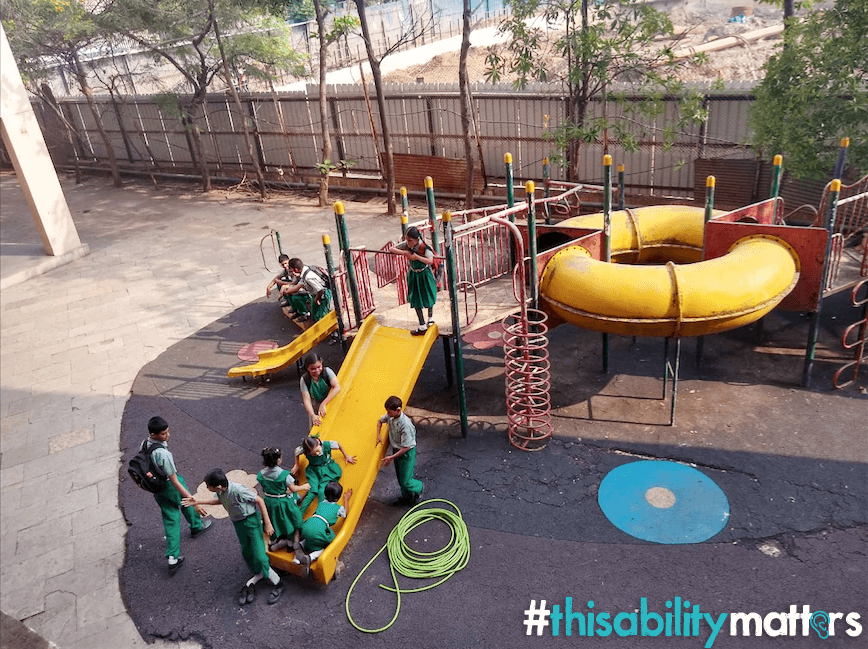
#ThisAbilityMatters is a co-created campaign with Save The Children India that aims to push the discourse on the need for self-reliance and independence of India’s disabled children.
The first day I walked into Save The Children India in BKC, Mumbai, I wondered what it would be like to be on the same campus as a school for children with disability. I’d never worked with people with disabilities before, and I had a few kindly thoughts in my head regarding the special school; thoughts that over the past four months have rearranged themselves to form a much more realistic narrative about a childhood in which disability plays a role.
- Children with hearing impairments will be quiet, I thought.
But they’re not! They use sounds – laughter, annoyance, sorrow – and signs. So the school is full of a different kind of sound. They stand around in the corridors during recess pulling each other’s legs, gossiping about each other or their teachers, playing games. Before school they play, organize small games for the younger children and sometimes slump down half asleep – clearly the day is going to be spent drowsing in class for some! Let’s be honest we’ve all had those days and some of us still do!
- Children with disability are kind to each other.
Hah! They’re children! Sometimes they’re kind to each other. Sometimes they shove each other. Sometimes there’s bullying.
One time, a child who also has an intellectual disability simply stopped on the stairs while going up to class after assembly. The children behind him waited. And waited. Chatted with each other. Then the child just behind him gave him a shove – go on! This child simply became even more still on the stairs. Refusing to move. There was a commotion further down the line with shoving and pushing and somewhat rude comments.
In a minute another child from the back of the line came forward and just moved the line around the child who was still on the stairs.
The teacher soon arrived and allowed the child time to decide what he wanted to do.
Another time I found two adolescent girls in a vehement discussion – clearly annoyed with each other. There was some shoving involved. Other children stepped in and broke it up.
Moral of the story – as with all groups of children, here too there’s all kinds of childhood behaviours. To expect otherwise is to reduce these children to their disability and deny them their right to being children.
- Parents of children with disability struggle to cope with them.
Yes, they do. But again that’s only one part of the narrative. Parents invest in small and beautiful ways in their children – spending a whole school day with the younger ones for instance, learning how to enable them to participate in a world of speech and language through an Aural Oral Communication Programme. Or taking the older ones to the local hairdresser to have their hair streaked. Or braiding their daughter’s hair carefully and elaborately on a special occasion. And yes, they often comment on the challenge they face especially to have their child socialize in family and neighbourhood gatherings. But more than that, they enjoy their children; play with them; scold them; cuddle them. Why on earth would I expect it to be any different!
- Children with disability are natural artists.
You know what – many of them are as much artists as I am. And that’s not saying much at all! No. Those with disabilities are not ‘naturally’ given to ‘alternative occupations’. Many of them are very interested in Maths, in languages or science. Many have academic aspirations. Some are really good at drawing. Others are simply trying to find their interest and talent the same as I was, at that age.
- Children with disability need kindness.
Yes. They do. As do all children. But they also need stimulation – games, music, competition, science exhibitions, maths kits….the same kind of holistic focus that we’re arguing is necessary in mainstream schooling. Part of our challenge is that we’re simply not investing enough in their intellectual growth – they’re curious and wanting to learn more. We need to step up.
My main takeaway from my own experience and observation is this – that even the most well-meaning among us tends to be reductive about children who have disability. The child becomes the ‘deaf child’, the ‘slow child’, and sometimes even the ‘thick child’. There is fear in engaging with them as they approach puberty and develop sexual preferences – as though it is distasteful for them to have sexual urges or fantasies as they grow through adolescence. And there is a reluctance to scold, and a cringing when we see someone else scold, a child with disability.
Why?
I’m teaching myself to see beyond the hearing impairment and the intellectual disability. To respect each child’s individuality. To engage in conversation. To ask questions. To join them in play sessions. And to confess that I can’t draw to save my life and watch them confess as well, before we turn to admire the work of their drawing teacher.
Leher is a child rights organization working to make child protection a shared responsibility. We envision a society where caring families, alert communities, and responsive governments come together to ensure the rights and protection of all children.
To read all our blogs click here & to read all our campaigns click here.